

Hi Multis
It’s Sunday again and that means the Overview Of The Week’s back!

The markets are always uncertain, but lately, with AI and its (supposed) consequences, it’s more uncertain than usual. But sun or rain, bull or bear, up or down, the Overview Of The Week is here!
I’ve written a lot this week and I was happy with this comment from Multi Kamran:
Thank you Kris ... one of your very best analysis! All the analysis articles since you came back from Omaha have been beyond awesome!!! Something happened with you when you visited us in the US!!
And yeah, in a way, I feel the same. I got soooo much energy from Omaha. It was my third visit and by far the best. And the two previous ones were already so great! It feels almost like a rejuvenation process, haha. Talking to fellow investors, newsletter writers, portfolio managers, company management, people working at family offices and so many other professional and passionate investors really fed my enthusiasm.
On top of that, the event I organized with Pieter Slegers (Compounding Quality) and Brian Feroldi (Long-Term Mindset) also made me realize how much my articles mean to some people. I sometimes read that here (see Kamran’s comment above, for example), but hearing it in real life cranks up the good feeling for longer.
In Omaha, maybe 20 or 25 people also recognized me and wanted a picture with me. No, I’m not talking about my picture with Mohnish Pabrai, haha. Ordinary people whom I don’t know came asking for a picture with me, saying that they love Potential Multibaggers. That really felt great, and so, if you ever see me in real life, don’t hesitate to come talk to me.
On top of the wonderful experiences in Omaha, I had been on holiday in Egypt two weeks earlier. That definitely also helped.
And I see more opportunities now, which I like more than if stocks are expensive.
But enough about me, let’s dive into what you are here for.
Articles In The Past Weeks
This is the fifth article this week. Let’s look back at what you got before.
The first article this week was the earnings deep dive on TransMedics. The stock dropped about 40% over the last two weeks. You can read here if that means it’s a buy now.
Another stock that dropped a lot this year is Shopify. It’s down almost 50% fropm its highs in 2025. Same question, same approach: an earnings deep dive.
Friday, it was the 15th of the month and you know what that means: the Best Buys Now. This time, in a slightly new format.
Yesterday, you got my article about Mercado Libre. It’s another earnings deep dive that talks about the context of the margin compressions and negative free cash flow. You can read it here.
Memes Of The Week
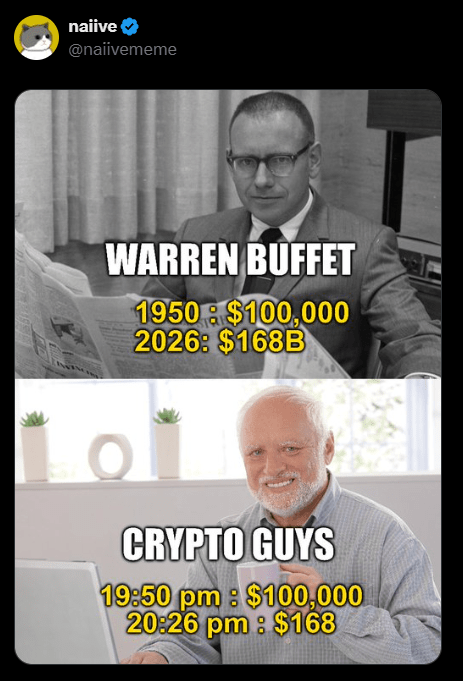
There’s a good harvest of memes this week. It’s the longest selection since I started this.
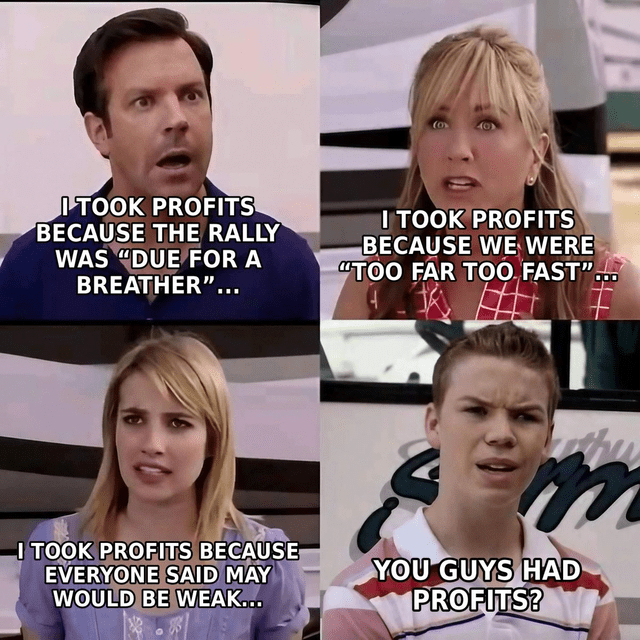
This is the first one.
The second one laughs at the arbitrary nature of trade patterns.

For the third one, you have to read the text at the bottom first, the JPM assumption.

It’s funny to laugh with other people, but real intelligence shows when you can laugh with yourself. So, this is about many of us. :-)
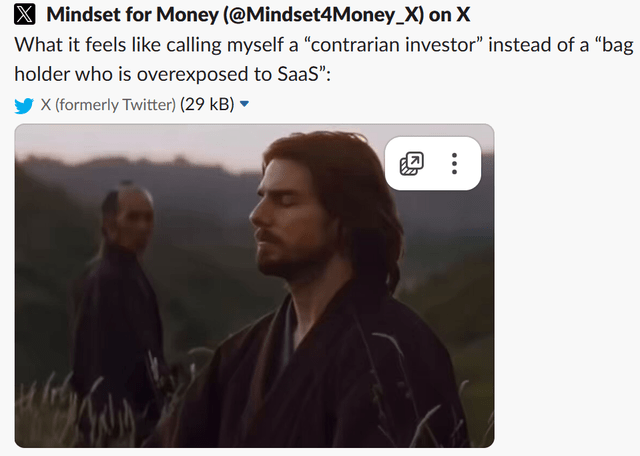
And I think we all know this situation.
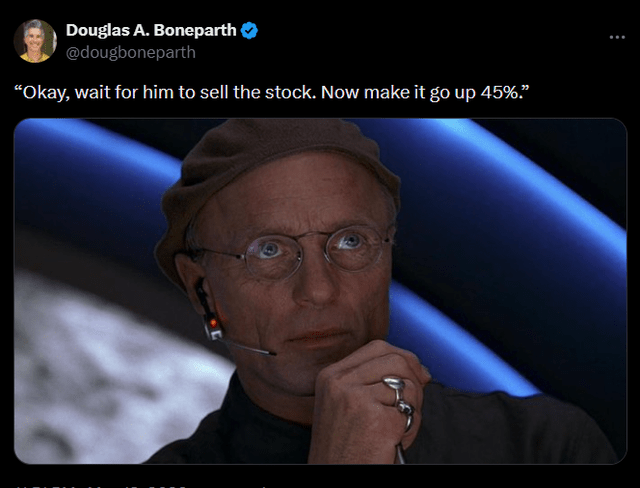
I made my own meme with this image.
And this shows that token costs hurt.

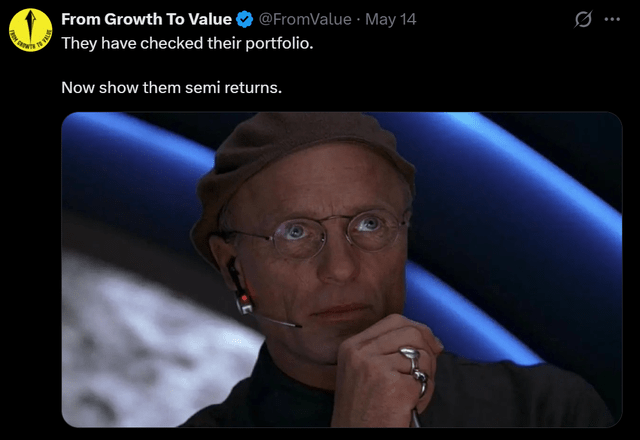
And we don’t stop yet. Here’s the next one already.
And the last one this week.
Interesting Podcasts Or Books
The Compound and Friends is a podcast that is sometimes a bit chaotic, but the takes are always interesting. I listened to this week’s episode about the Nasdaq euphoria. You can listen to it here. I also listened to an episode of the great podcast series Founders. David Senra talks with Eric Jorgenson, the author of The Book of Elon, about, you guessed it, Elon Musk. It’s an interesting conversation on how Elon Musk functions.

The third podcast I listened to and that I want to recommend (I listened to more) was an older one that was still on my list. In the podcast In Good Company with Nicolai Tangen, the CEO of the largest single investor in the world, Norges Bank Investment Management, talks with interesting guests and Reid Hoffman is such a guest.

Hoffman was at Apple in 1994, founded a social network company called SocialNet in 1997 and was part of the Board of PayPal when it was founded. He became the COO of the company in 2000 and was part of the PayPal mafia, as the group was called. He then founded LinkedIn in 2002 and joined the Board of Microsoft in 2017, after Microsoft bought LinkedIn in 2016. He was also one of the first who gave capital to OpenAi in 2016 and joined the Board until 2023. Since then, he co-founded and funded several AI startups.
You can listen to the conversation here.

The markets in the past week
This is what the markets have done in the past week.
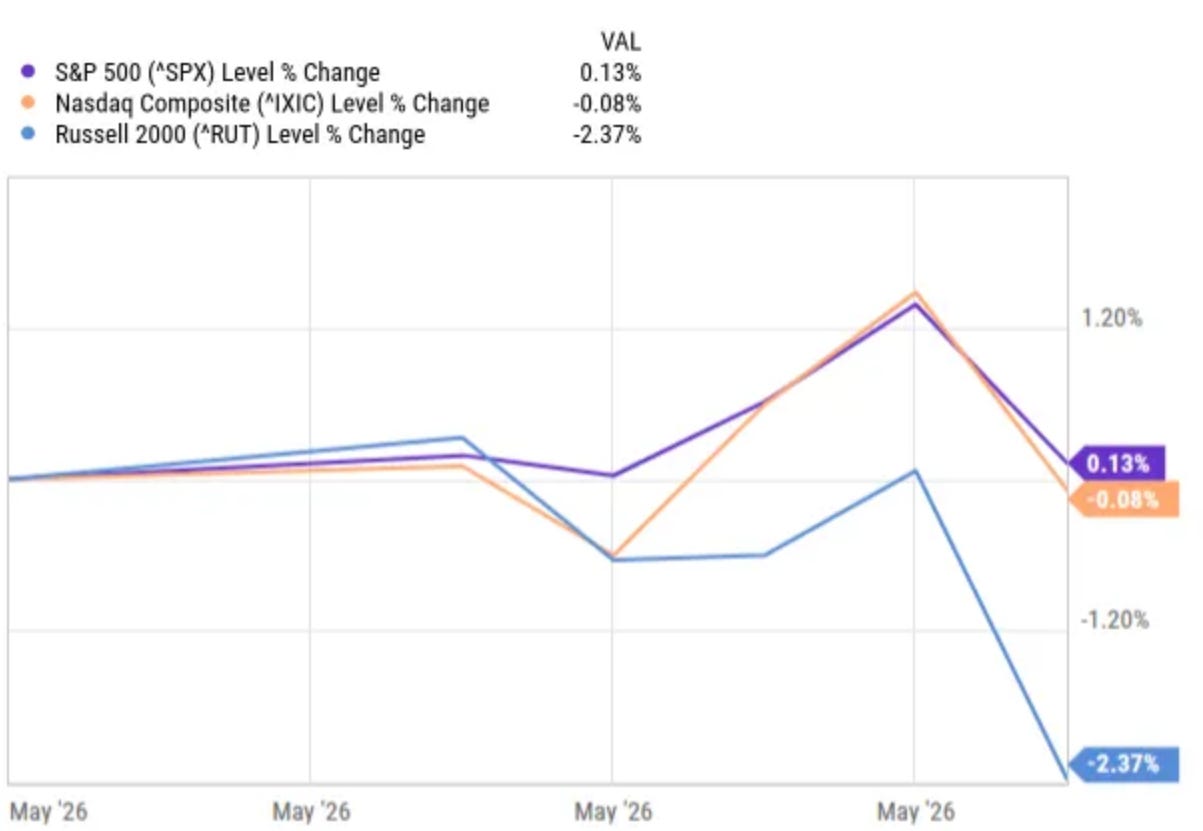
As you see, the S&P 500, up 0.13%, and the Nasdaq, down 0.08%, didn’t move much. The Russell 2000 dropped 2.37%.
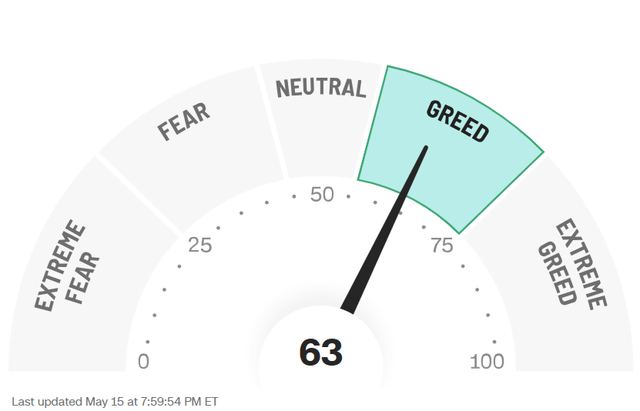
The Greed & Fear Index remained in Greed territory.
Quick Facts
1. Why This Is Not Like The Dotcom Bubble
Last week, I wondered if the top was near. This week, I want to add some more thoughts about this.
First, I don’t think this is like 2000 yet. Markets are not as expensive as they were back then. I hear some people saying that. It’s nonsense. For example, Cisco traded at a forward PE of 150 at the time. Nvidia now? About 27. That’s a difference.
Maybe you think that this was the exception, but that’s not true. Look at this chart shared in the episode of The Compound & Friends I already referred to.
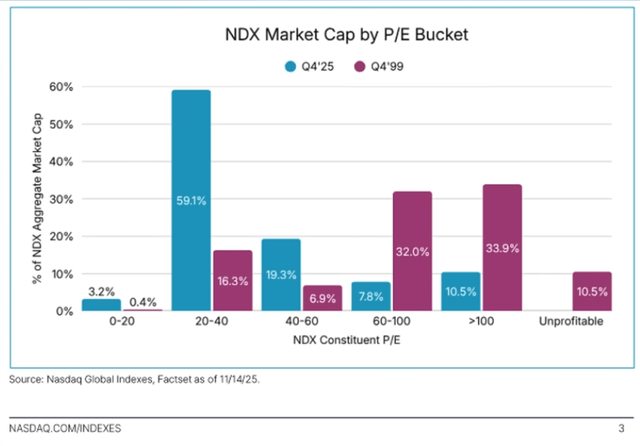
As you can see, the valuations were much, much more expensive back then. Now 59% of companies in the Nasdaq trade at a PE between 20 and 40. Back then, 76.4% was either unprofitable or traded at a PE above 60. So, no, this is not the same as the dotcom bubble.
This is another aspect of it, margins.
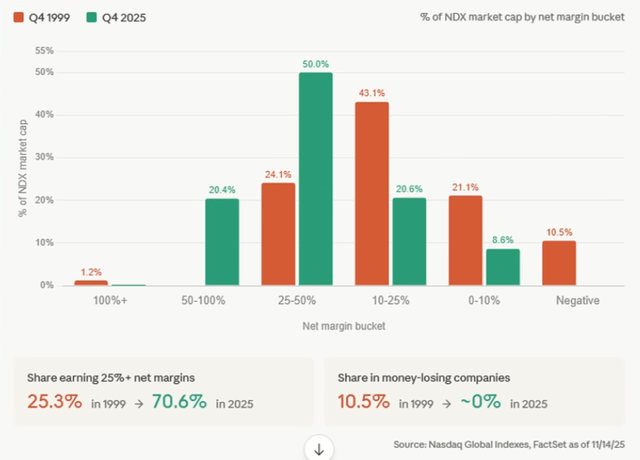
So, back then, 10% of the companies had negative margins. Now? None. There were no companies with margins between 50% and 100%. Now? 20.4%. If you look at 25% margins or more, then it was just 25.3%. Now 70.6%.
Things have changed. We live in the information economy now, not the mostly industrial economy of more than 25 years ago.
On top of that, there were hundreds of IPOs by companies that had one thing in common: they said they were internet companies and had no revenue yet.
Maybe you have seen this chart.
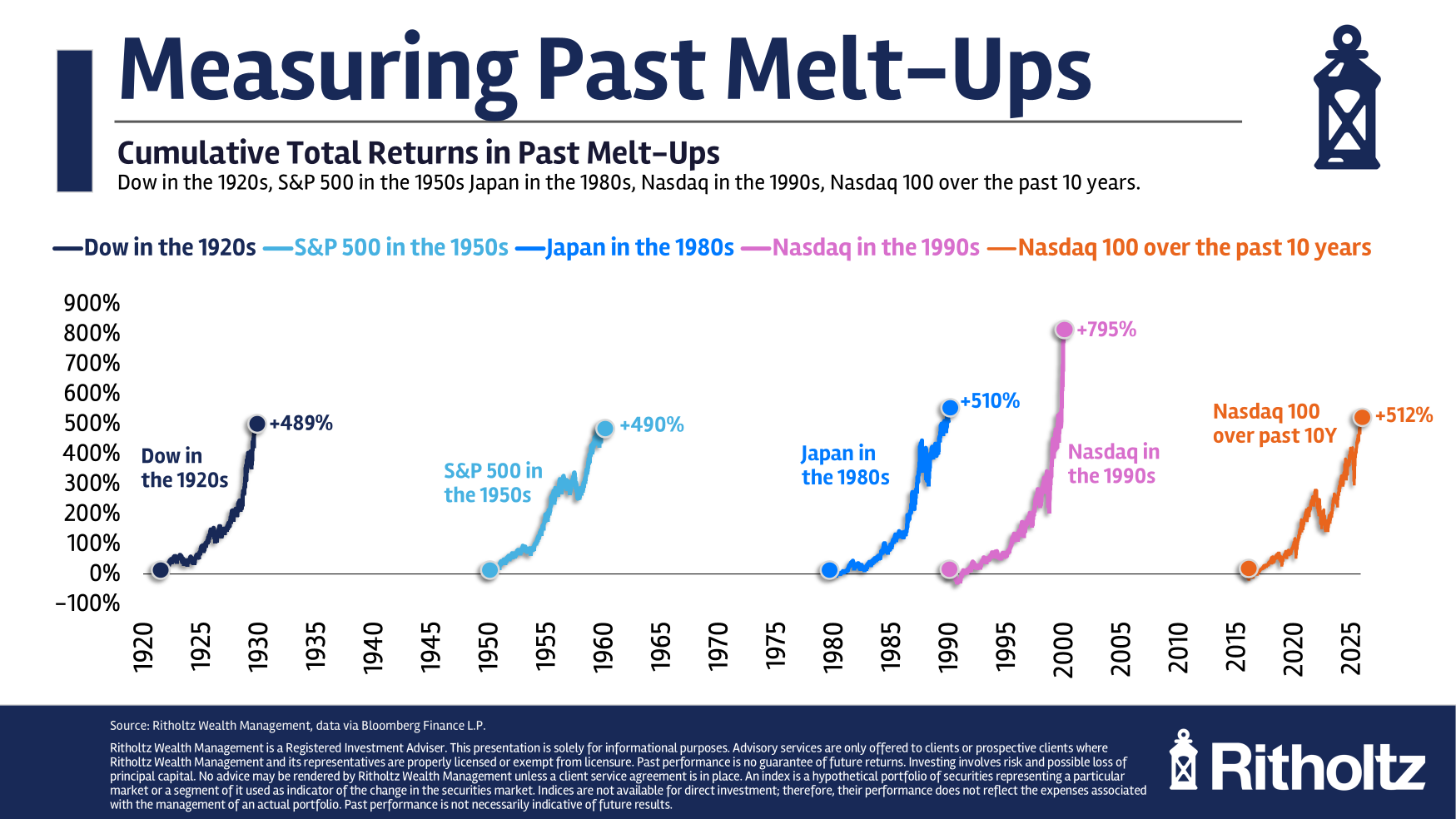
It looks pretty scary, right? But with what you know now, it’s extremely unlikely that the market will drop 80% and take years to recover like back then.
Of course, a drop is always possible, but don’t be afraid of a dotcom scenario. Or at least not up to now.
Productivity is already scaling now, unlike then, the valuations are not like they were then.
For commodity products like memory, there will definitely be a bust at some point. I’m talking about Sandisk, Micron, etc. When? No idea. But if you look back at EVERY single infrastructure outbuilt in the past, that happened at a certain moment.
You saw the same in the infrastructure buildup for the internet. It’s not that we suddenly used less bandwidth in the early 2000s, to the contrary, but there was overcapacity because of efficiency jumps in internet delivery.
I think the same will happen now. I’m not worried about companies like Nvidia and AMD, as they have truly differentiated chips, but memory chips aren’t as high-tech as state-of-the-art GPUs. That’s just demand and pricing and if you look at the history of chips, especially those, they have always had a boom-and-bust cycle. Look at these charts and you will see what I mean.
This is Sandisk.
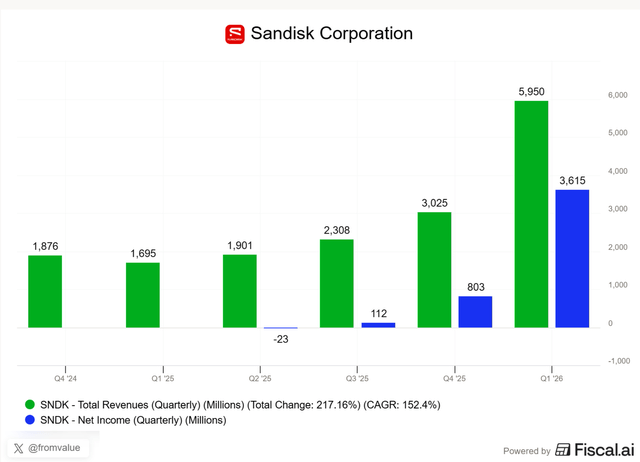
Look at revenue. It had a great jump, of course. But now look at net income. It was still negative in Q2 2025 and in Q1, it was already at $3.6B.
Ok, look at Micron.
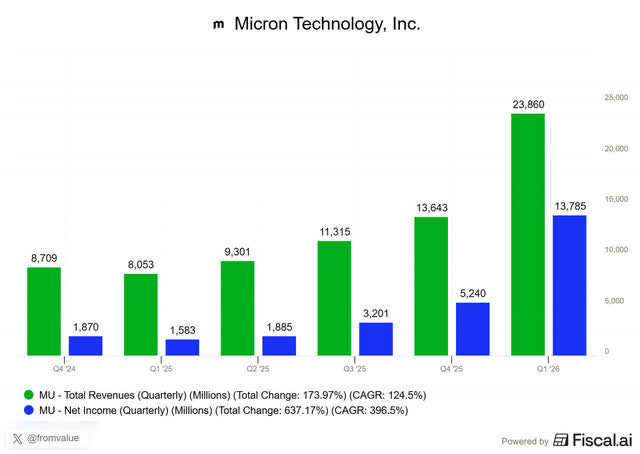
Sure, Micron started at a higher income base. But, it’s the same pattern, revenue is up big, but net income much more. You can see that in the CAGR of 124.5% revenue growth, but 396.5% net income growth.
How is that possible? Simple. Pricing. Memory chip prices have ballooned because there is a shortage of memory chips. Once that imbalance is fixed, prices will drop by two-thirds or more. The question is when there will be more supply and/or when there are AI efficiency gains. I don’t foresee this going away anytime soon, so if you are a trader, I think there’s more juice in this lemon than you might think.
As for the market, I see two scenarios: the market will go down soon or it will continue to go up, haha. I’m making fun of it, but I mean it seriously.
Either the market lets off some steam soon (meaning in the next few months), which would be healthy, or the melt-up continues and that will only make the drop bigger.
But history seems to suggest that there will be a drop.
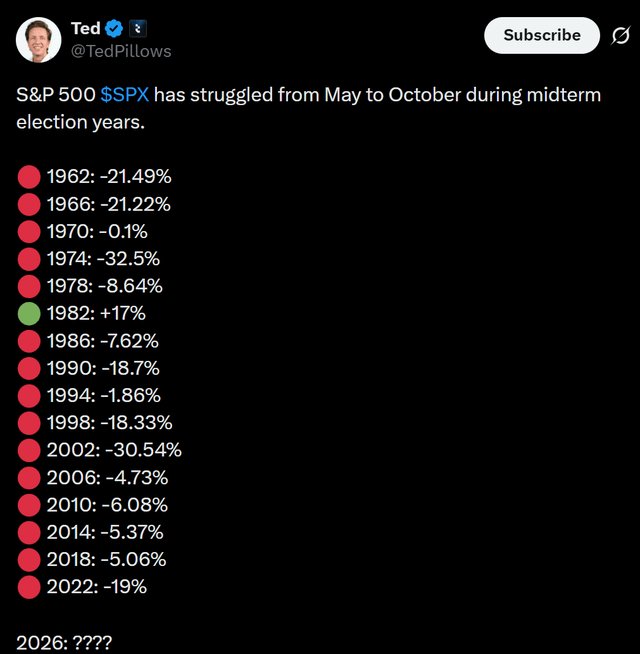
Beware: just because that’s what historically happened doesn’t mean it will now. But it’s possible. As always, we’ll have to see.
I get questions about where the system could break. Well, I don’t know. There are always many possibilities. Think of a black swan event, which is inherently unknowable. Or it could be spiking inflation. Or maybe it’s this.
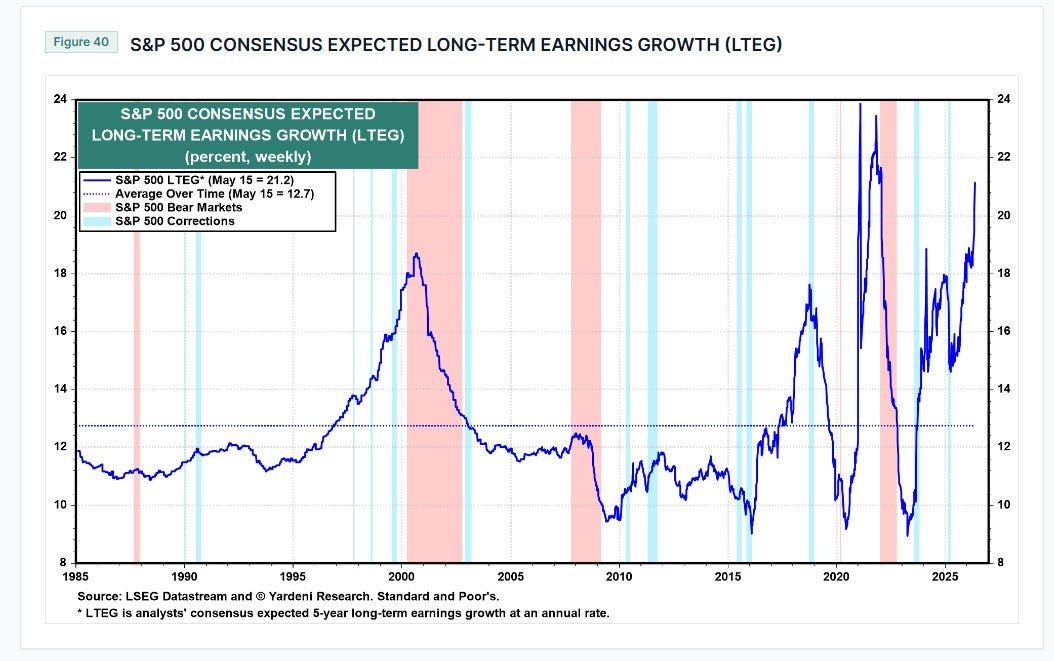
The earnings expectations for the S&P 500 for the next 5 years are now at 21%. That’s very high. Any disappointment there and the stock market tumbles. That’s how this game is played. And I don’t think it’s too crazy to expect lower EPS over the next 5 years. We all know about the gigantic capex the Mag7 and others are taking on now for data centers. You can’t extrapolate that line to the next five years and maybe some have, which could influence the average expectation.
Or will it be the new Fed Chair that causes pessimism in the market? I saw this graph.
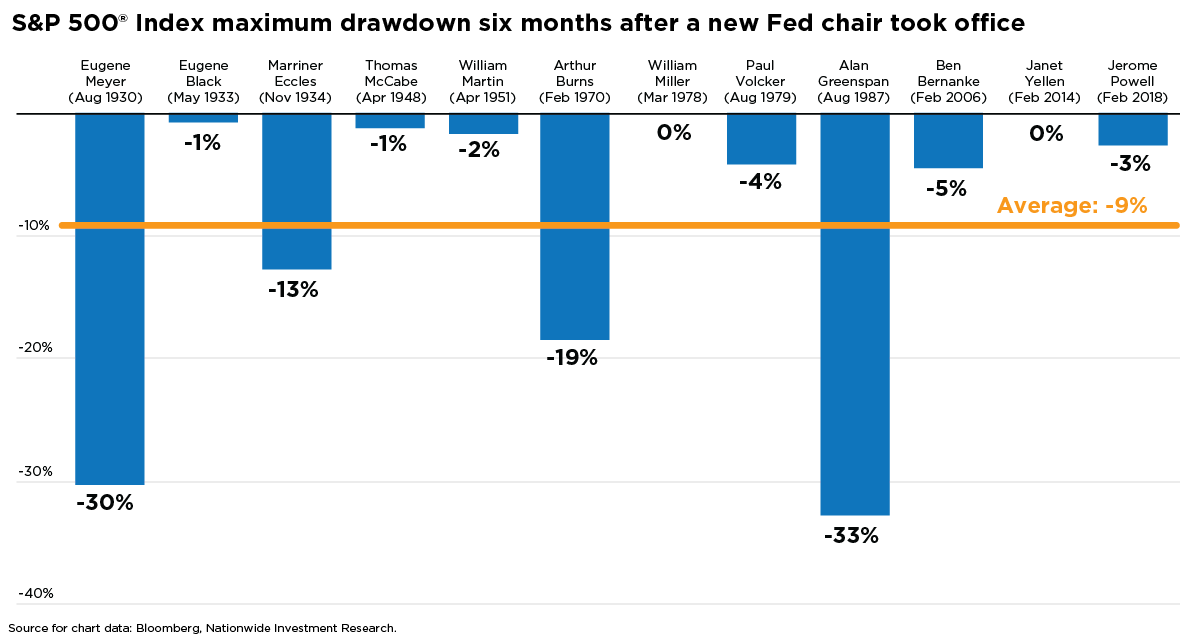
I should add again that I generally don’t draw too many conclusions from such charts. As so often, correlation is no causation. But still, it’s interesting to see.
I think that everyone who has followed me for some time knows I’m generally very optimistic. But I can’t close my eyes for certain things. That’s not optimism but pink glasses. I look at reality as it is and I believe things will turn out well. I do now as well, even if the stock market does not do great over the next few months or so. It will be a temporary hiccup. If it comes, that is.
2. Which Companies Are Interesting Now?
As you know, I invest in other stocks than the Potential Multibaggers as well. For newer readers, you could see that in the Best Buys Now article and in my portfolio, which is linked there.
In that context, I find this chart interesting. I had not seen it before I bought for my portfolio this week, but look, two of the stocks I bought are above the second line, the highest quality. Nvidia is, not surprisingly, the king of the heap.
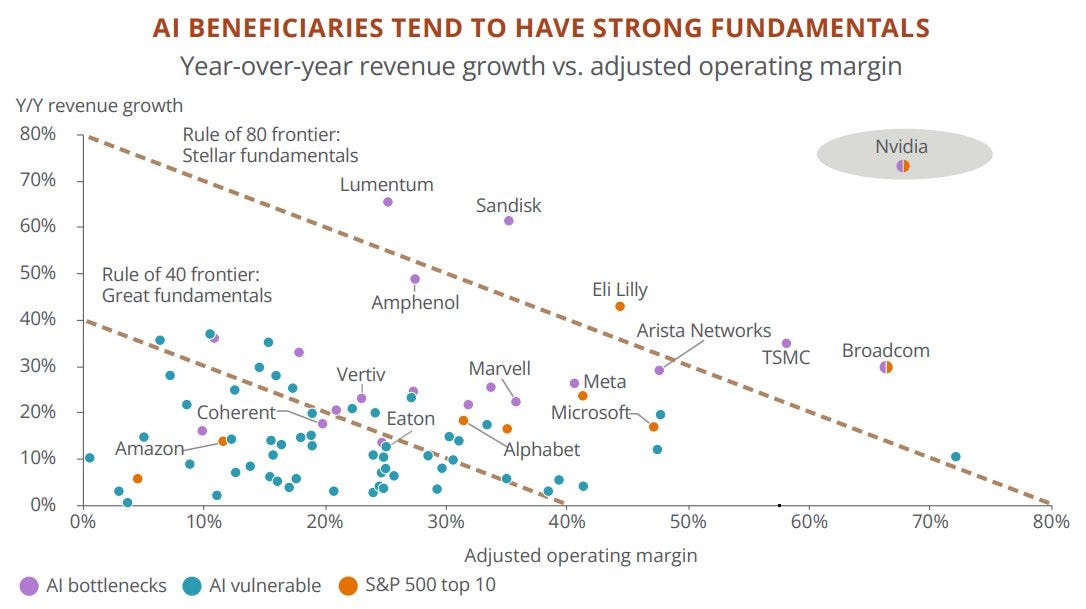
I think if you look at the AI bottlenecks, you see that multiple big winners. And Coatue put that in a great visual.
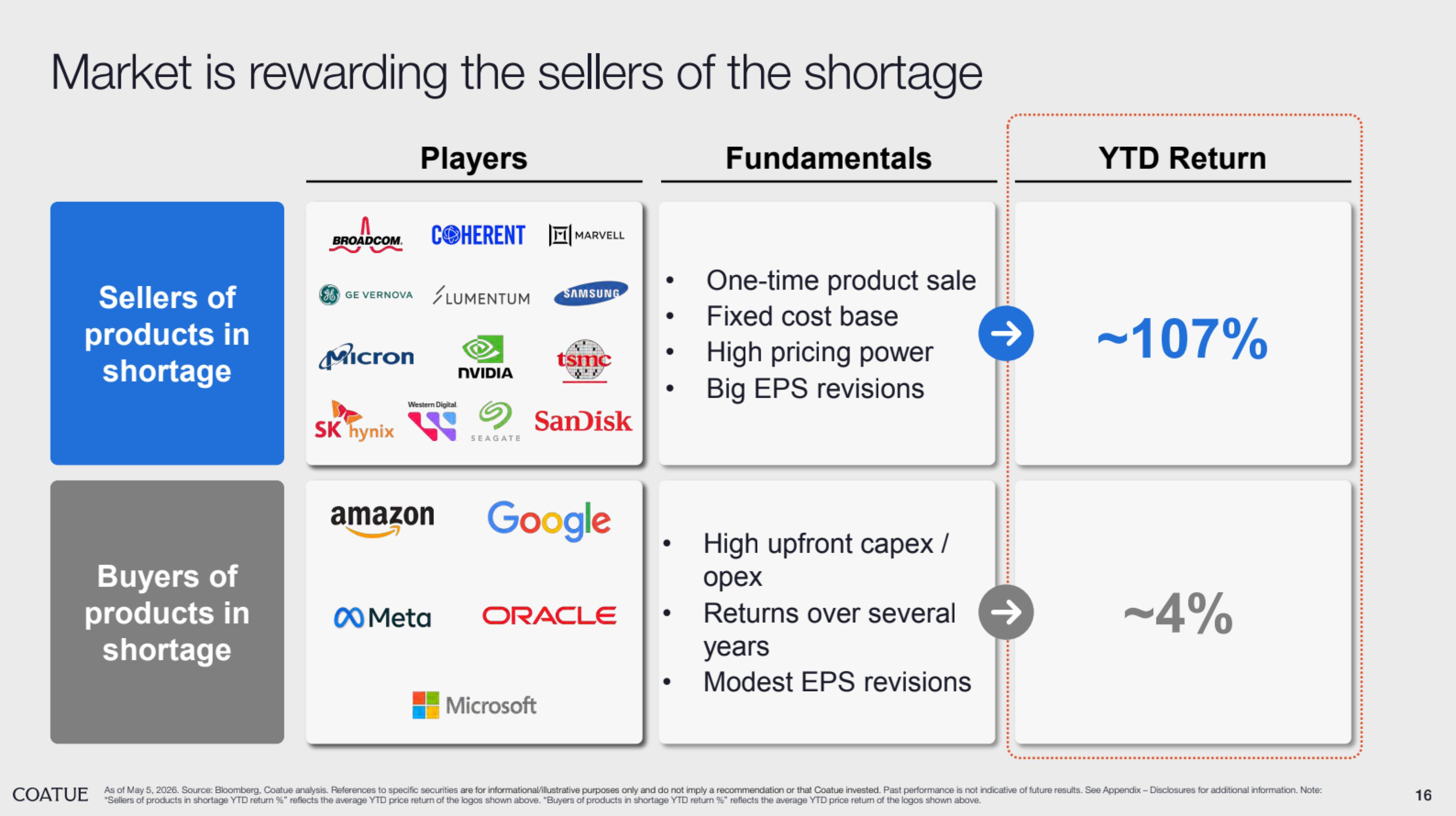
In the past 15 years or so, the Mag 7 has performed phenomenally, but will that continue? Their margins are no longer that high because of the huge investments they make and it’s very questionable if they will return in the first years, if they return at all.
On the other hand, they know that they have no other option. They have to spend to stay in the race. If they don’t do it, they will definitely be disrupted and that could cost them their existence as a relevant company.
Now, I know this still doesn’t really answer the question in the title of this paragraph. Which stocks are interesting now? Interesting and attractive are not the same, of course. I see a lot of interesting stocks that I wouldn’t want to touch now. On the other hand, there are also more attractive stocks because the AI trade drew money from elsewhere, mostly, but definitely not only, SaaS. Look at these two beauties, for example.
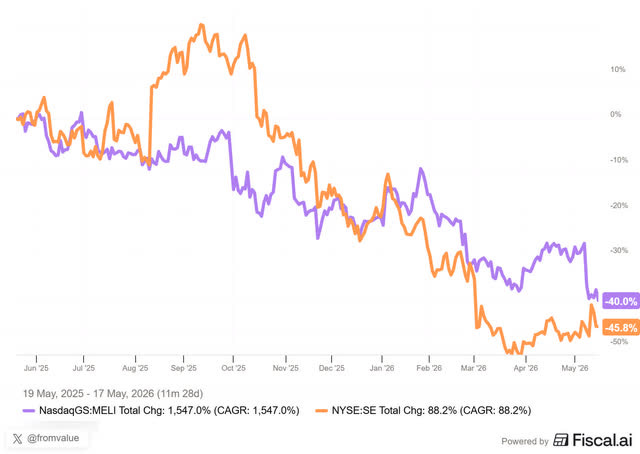
Just saying.
3. The SpaceX IPO
The new milestone for the market has a date: June 12. SpaceX will have its IPO on the Nasdaq on that day under the ticker SPCX. The company aims at a valuation of $1.75T to $2T.. That’s insane. It wants to raise $75B, which makes it by far the largest IPO in history.
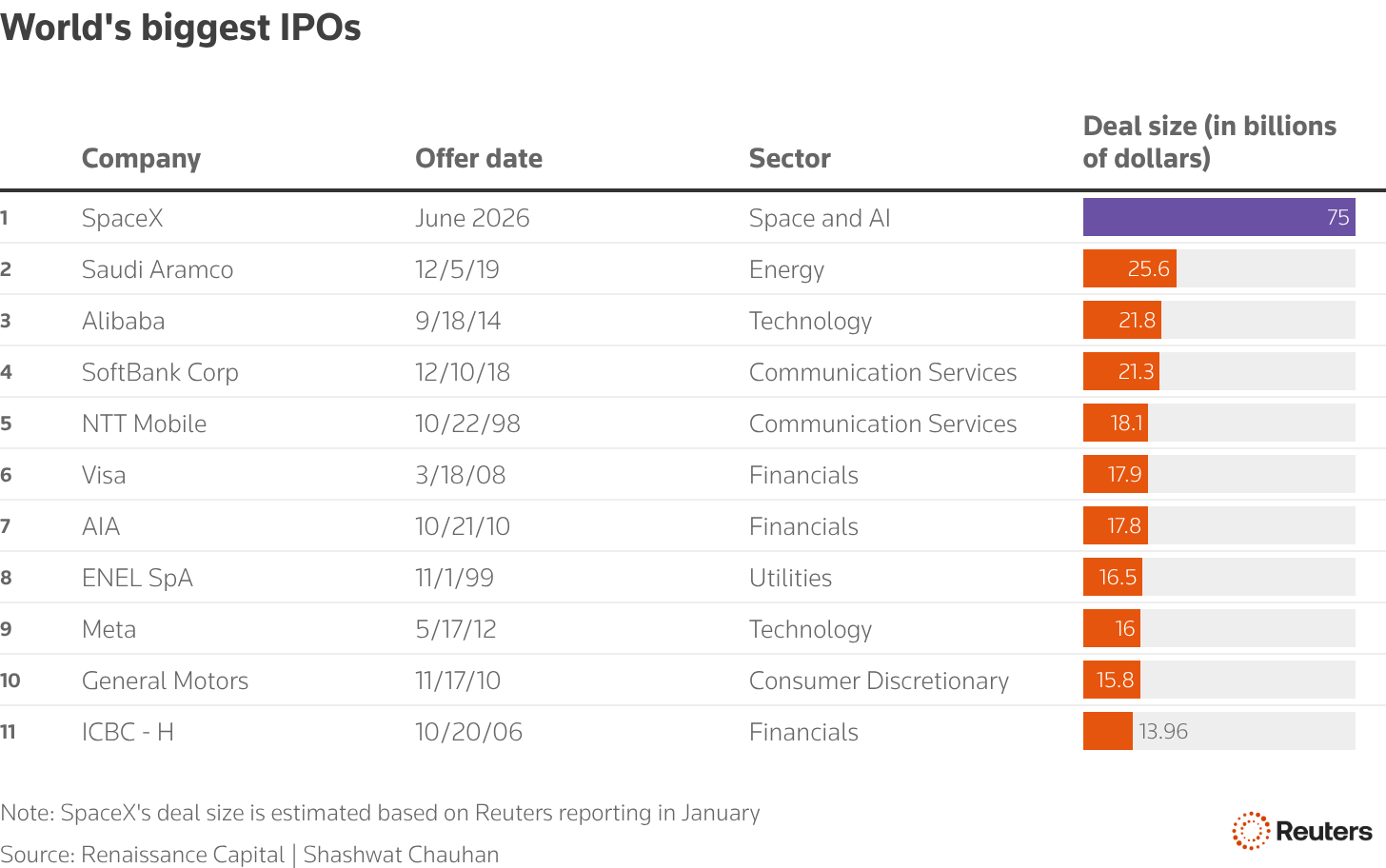
And no IPO without hype. After all, an IPO must be sold. Analysts called this a ‘Netscape’ moment. The Internet browser went public in August 1995. The shares were planned to go public at $14, were offered at $28 with a last-day change, opened at $71, reached $75 and closed at $58. It’s seen as the start of the dotcom bubble.
And yes, the peers of SpaceX immediately had incredible gains this week. Just look at these two: Rocket Lab and AST Spacemobile.
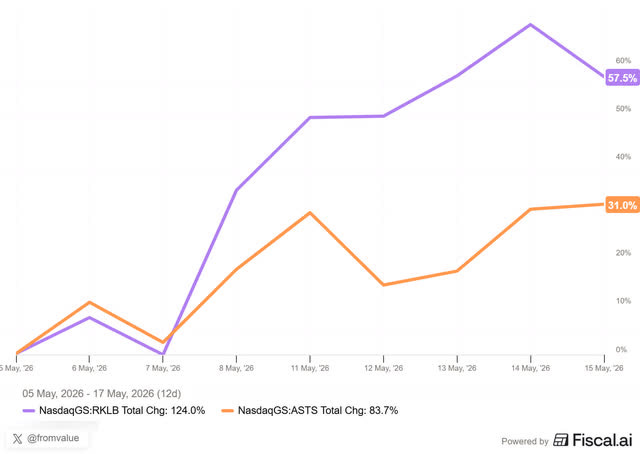
But the exceptional size of the IPO also has disadvantages. cut both ways. Some fear that the IPO will vacuum up even more liquidity from other places. SpaceX holds thousands of BTCs, and there is a fear that crypto traders will prefer SpaceX over crypto.
And talking about that, there’s a new Fed Chairman period. Look at this.
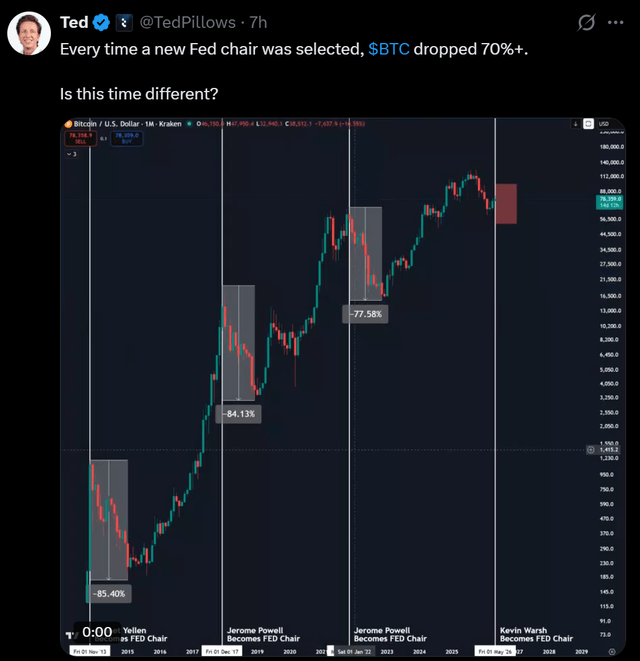
Now, as with so many things in the stock market, this is correlation, not causation. I think the SpaceX IPO could have a bigger effect on crypto than a new Fed Chair.
But back to SpaceX. MSCI and other index providers warn that SpaceX’s giant IPO will force big changes to benchmarks. Passive funds will have to buy massive amounts of the stock, and that could distort the market allocations for months. For months, meaning for six months, when the lock-up period ends. Then dozens of funds will dump SpaceX shares on the market.
Why? Because they are so overweighted SpaceX. They invested in private rounds and couldn’t sell. Scottish Mortgage Investment Fund (Baillie Gifford) for example, has a position of probably bigger than 15% of the fund and at this valuation probably more than 20%. They will want to take a big part of those gains. And they won’t be alone.
That could have effects for the market in another way. If all the money flows out of SpaceX, it could flow back into the market, into other stocks and that cause a new stock market impulse towards the end of the year.
Of course, that’s just theory. In theory, reality is easy, but in reality, it’s not.
If you are a free reader, it stops here for you. You do realize that I keep the best stuff for paid subscribers, right? If you want all the advantages of a paid subscriber, you can subscribe now.