

Hi Multis
As I start writing this Overview Of The Week, the autumn sun is shining in my home office, and I’m listening to some of my favorite music (AC/DC’s Thunderstruck just switched to Joy Division’s Love Will Tear Us Apart Again).
In other words, the conditions are perfect for one of my favorite weekly activities: writing the Overview Of The Week.
Here we go!

Articles In The Past Week
Just like last week, you got four articles this week, including this one. Let’s look back at the three previous articles.
The first article this week was a review of Hims & Hers, from everything in Q2 to what happened up to now. You can read it here.
Adyen has been a disappointing stock over the last years, but its business keeps growing reliably. What happened exactly? You can read more about that here.
Since my last analysis, when I rated Global-e a Strong Buy rating and gave it a 9.5/10 Valuation Score, the stock has shot up 35%. So it’s time to analyze the results and update the valuation. You can find the conclusion here.
Memes Of The Week
I had to laugh with this meme, because it captures what I have been experiencing myself.
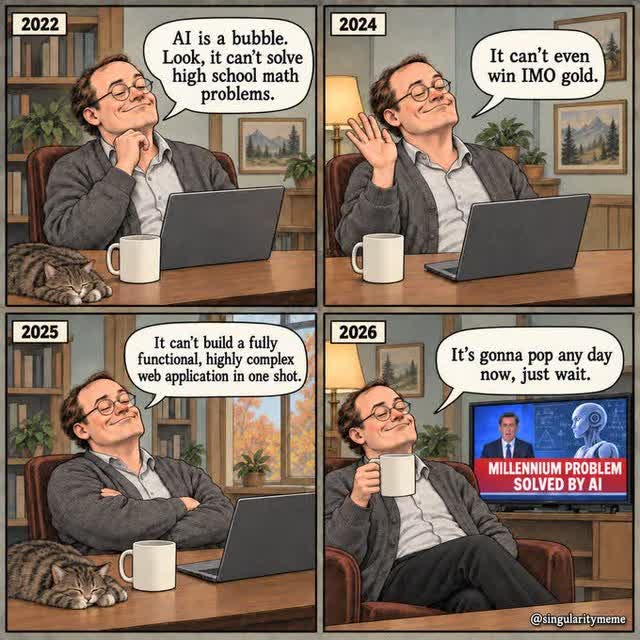
It’s now the consensus between funds and the ‘smart money’ that this is a bubble. But what these people often have in common is that they look from the outside in. That can sometimes be an advantage, but sometimes insiders just know more and I hear completely different opinions there.
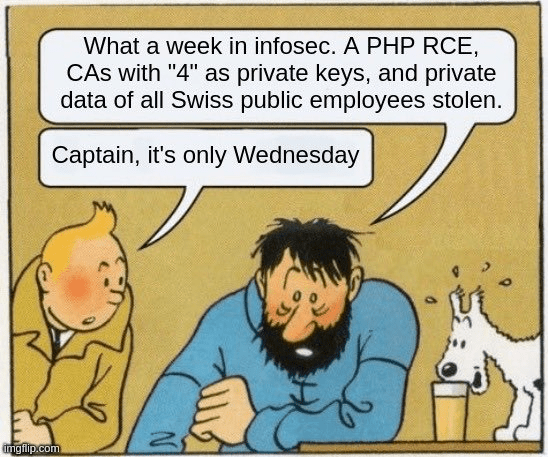
Not really a stock market meme, but one many who follow tech will still chuckle about. Thanks, bep, for sharing.
Interesting Podcasts Or Books
This week, I listened to Patrick O’Shaughnessy’s Invest Like The Best, one of my favorite podcast series. His guest was David Vélez, founder and CEO of Nubank. The episode was released almost two weeks ago, but I only listened to it this week.

If Nubank was not a big position yet, after this interview, I would definitely consider it, haha. David Vélez shows why so many think he’s one of the best CEOs out there. It’s 1 hour and 21 minutes, and worth every second.
The markets in the past week
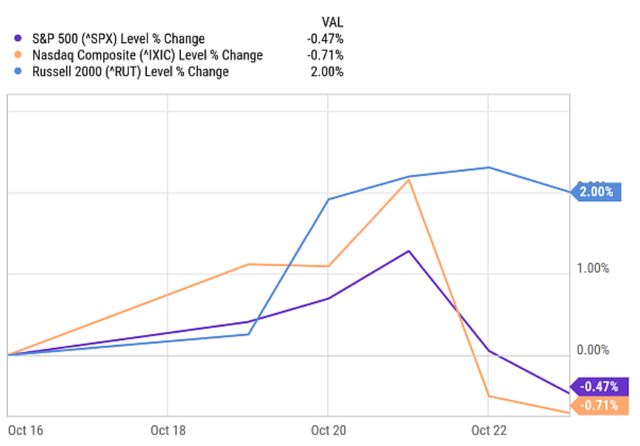
We have seen some strange patterns in the returns lately, and this week was no different. The S&P 500 lost 0.47%, the Nasdaq even lost 0.71, but the Russell 2000 was up 2% this week.
The Nasdaq has done worst lately. That’s spurred by the losses in the semiconductor sector. The Semiconductor ETF is down 19% over the last three weeks.
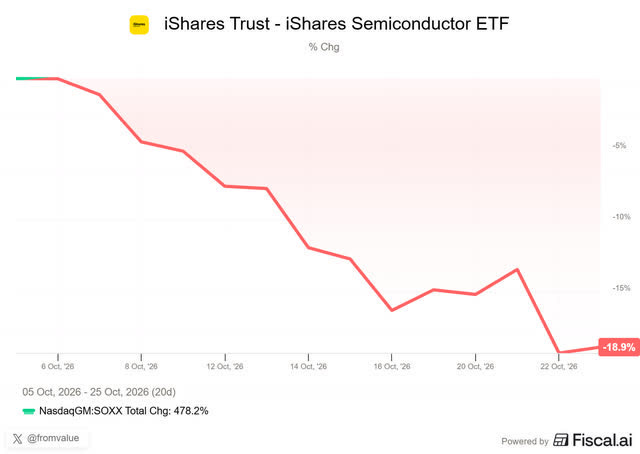
Semiconductor ETF decline(Fiscal.ai)
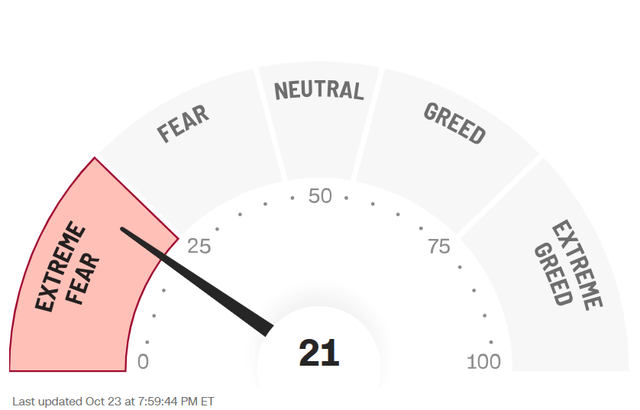
The Greed & Fear Index remained in EXTREME FEAR.
Quick Facts
1. AI Chips: Prices up, not down
You often hear that AI chips lose their value very fast. Nvidia ( NVDA) launches a new generation every year, so the older chips should be worth less and less. The rental prices paint a different picture.
This week, a16z posted this:
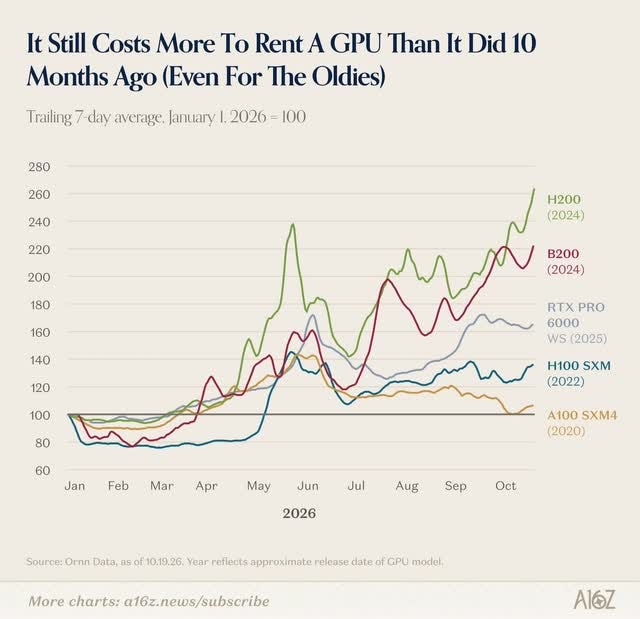
It’s a chart of AI chip rental prices year to date. As you can see, all are up and all but the A100 multiplied.
This graph is probably even more important.
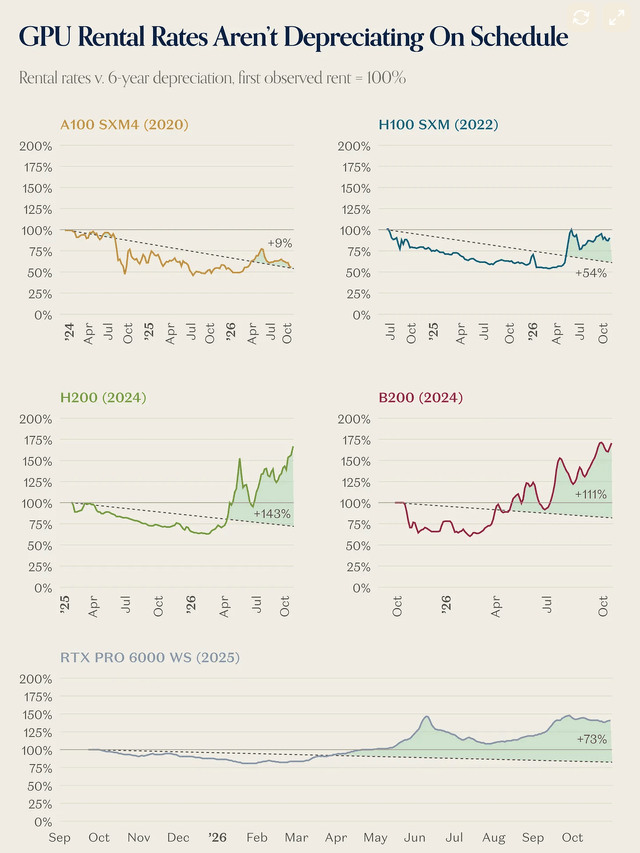
It’s important to understand this graph. The dotted line shows where the rent would be if it went down steadily, as if the chip lasts 6 years. The green area is where the rent is above that line.
That 6-year depreciation period is the one Michael Burry called a fraud. He shorted chip stocks because he believed depreciation should be 2 years, maybe 3 at most. This chart proves how wrong he was.
As you can see in the chart, every chip is above that supposedly aggressive depreciation baseline. The H100 is 54% above, the B200 111%, and the H200 even 143%. Even the A100, which is already 6 years old, is still 9% above the line.
The older chips should be cheaper to rent than they are right now. Granted, for a while, rent was under the line, but this is just from this year.
Right now, it costs about $57B to build a gigawatt and you can expect a return of $40B per year. In other words, the costs are paid back for 70% in year one. Suppose you could pay back the cost of a house in less than a year and a half, would you buy more houses? That’s basically what happens, except you fully expect demand for the houses to explode for years to come in a way that’s actually unrealistic for houses.
There’s another strong data point that proves that there’s no slowdown in AI demand; to the contrary: Amazon ( AMZN). On the a16z podcast with Ben Horowitz and Erik Torenberg, CEO Andy Jassy said that AWS is sold out for 2026, largely sold out for 2027, and that a good chunk of 2028 is sold out too. He doesn’t think the memory shortage ends in 2027 either. It’s the same we hear from chip and memory companies.
Amazon expects to spend about $220 billion on capex this year. That’s about $600 million per day. And still, Jassy says Amazon is leaving a meaningful amount of demand on the table. Amazon reports its Q3 results on Thursday.
So, why the sell-off then?
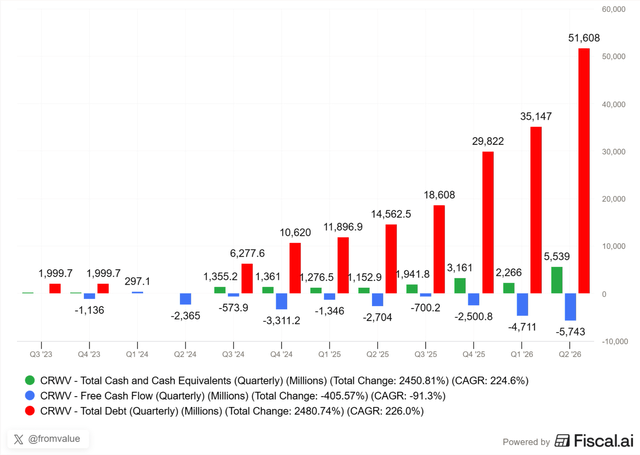
The market starts to differentiate. Interest rates are up and that means that companies like CoreWeave, that borrowed a lot of money to buy chips, are questioned. For good reasons. If CoreWeave were a Potential Multibagger, it’d sell it because of this alone:
Elon Musk, never too shy to express his opinion, wrote this on X:
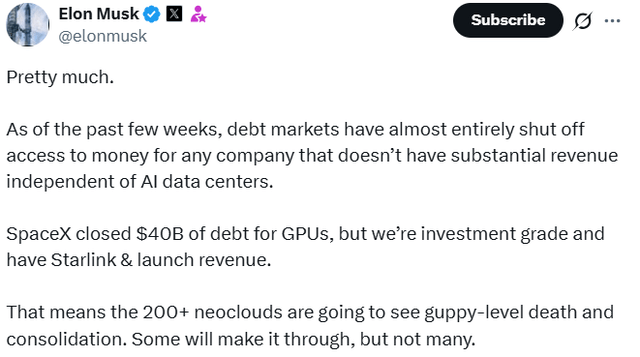
I think he’s already waiting to scoop up the GPUs from the neoclouds.
2. The Bear Market Under The Surface, pt.2
Last week, I already wrote about the bear market under the surface. This is another element in that same story.
If you only looked at the S&P 500, you’d think nothing happened but under the surface, many stocks are suffering. This week, I saw this chart.
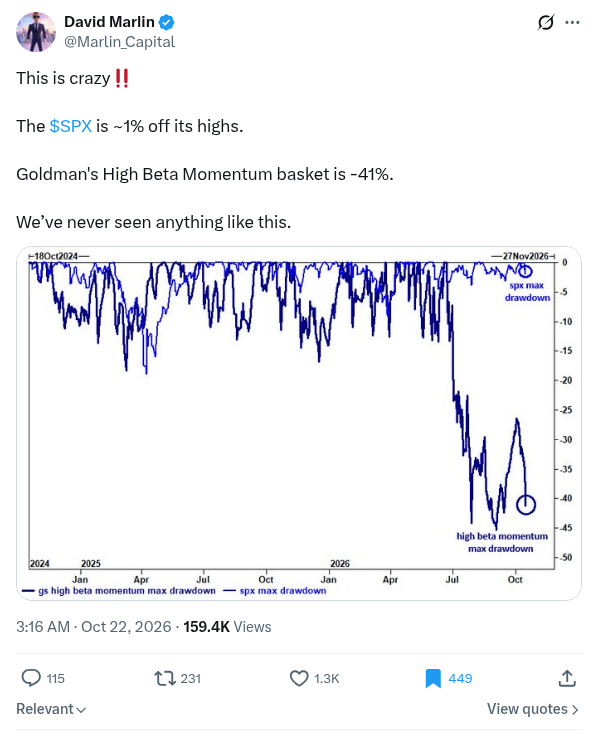
Tech hedge funds lost about 10% in October and Asian hedge funds about 9%, according to Reuters.
The consequence is easy to predict: money rotated out of AI infrastructure into the rest of the market.
3. The Anti-AI Bubble Starts Working
Do you remember the term I used so many times in the first half of this year? The Anti-AI Bubble.
What I meant was that everything seen as potentially impacted by AI was sold as if it were already dead. Every Anthropic product release was received like manna from heaven. Semiconductors were growing like there was no tomorrow but SaaS, cybersecurity and many other stocks were sold off.
Guess what happened in the second half of the year? Look at this chart:
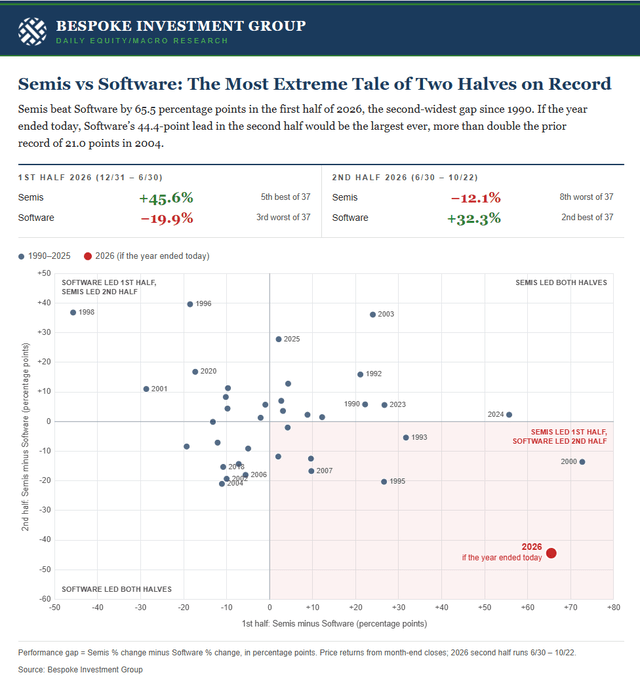
So, in the first half of the year, semis did 65 percentage points better than software, but in the second half so far, software did 44 percentage points better so far.
Here are three of the stocks I bought (ServiceNow) or added to (CrowdStrike and Cloudflare), from April to now.
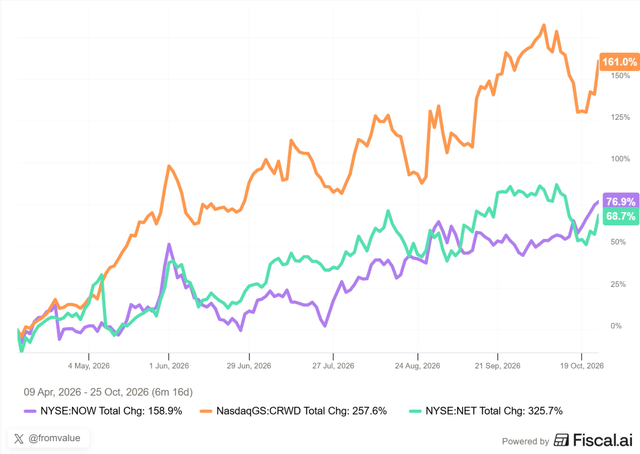
Of course, I added some stocks that were much less successful, but a few outsized winners lift you up.
In other words, the anti-AI bubble was that, a anti-bubble and that is starting to suck in air again now.
There’s now more net selling, comparable to March, almost the bottom then.
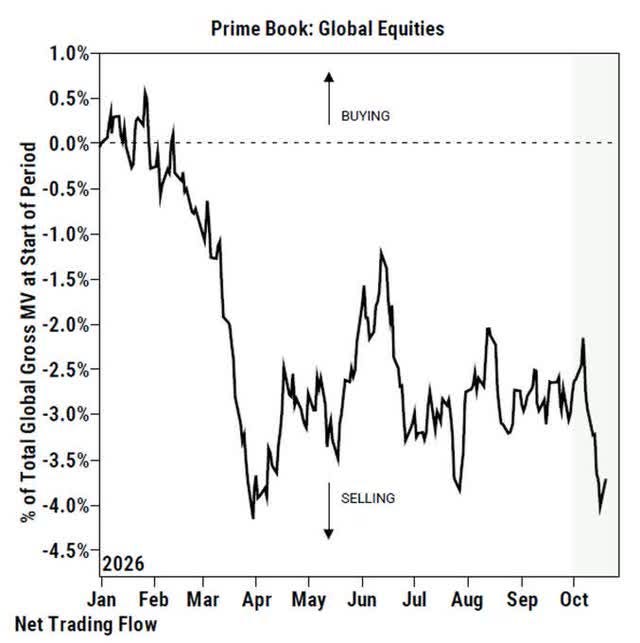
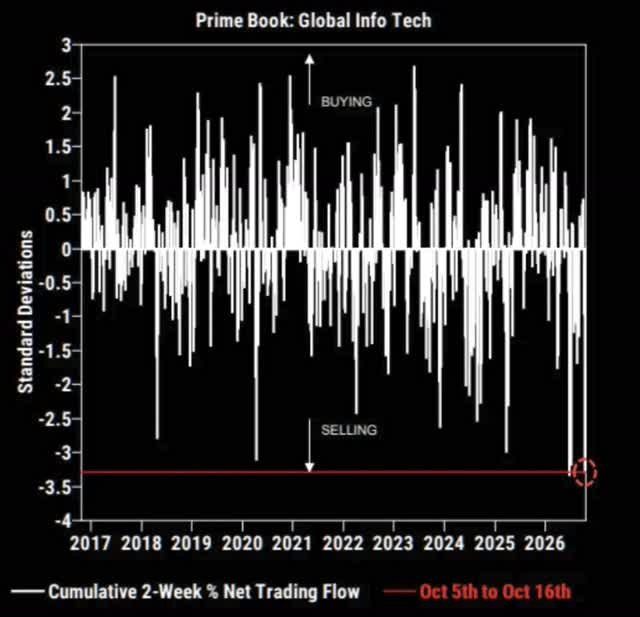
This Goldman Sachs chart shows that a lot came from tech, that saw the biggest selling pressure in the last decade.
Short leverage, so how much a hedge fund borrows to bet on stocks dropping, is close to the highest level in 5 years.
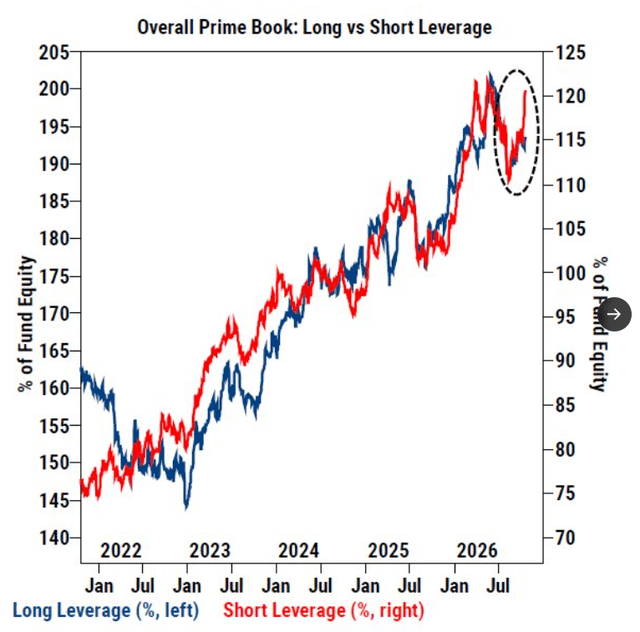
But that also means that if traders who sold the stocks have to buy those stocks back, there could be a furious rally.
And valuations? Liz Ann Sonders of Schwab shared this chart.
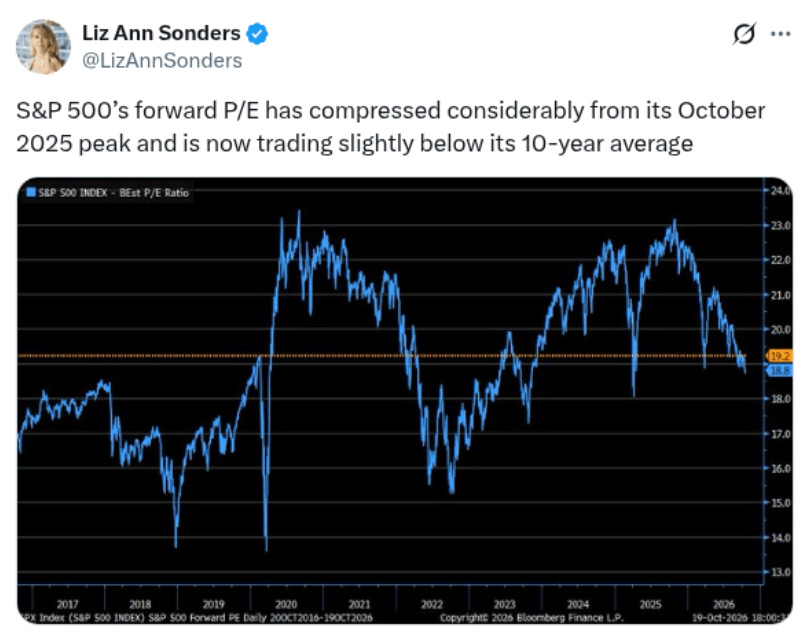
The forward P/E of the S&P 500 has compressed quite a bit from its peak in October 2025 and is now slightly below its 10-year average, around 19x.
Tech is even cheaper and it’s quite a bit below its 5-year and 10-year average.
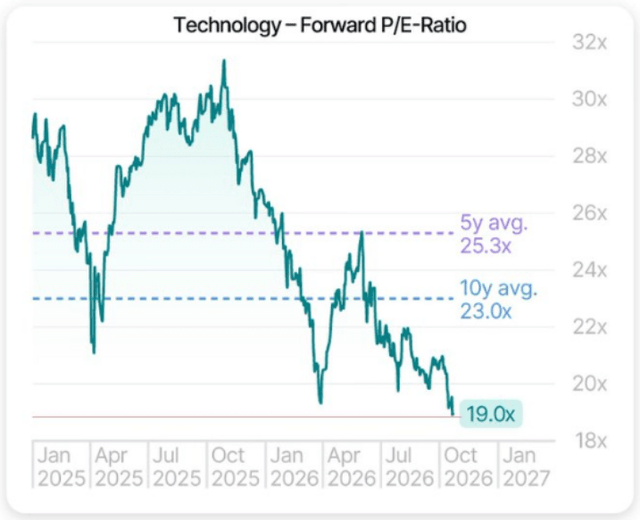
That’s mostly because earnings grew, not because prices fell. So, it all comes back to what you believe: there’s earnings inflation, with AI showing unsustainable earnings, or this is healthy. But of course, that’s very black-and-white thinking. I think it’s perfectly possible it’s a bit of both.
There are even rumors that some hedge funds have blown up again. Leopold Aschenbrenner’s Situational Awareness is even named again. That would be the third time, but I don’t know whether to take this rumor seriously.
Just before I finished this Overview, there was news that might change what I buy tomorrow or Tuesday. It’s in quick fact 10.
Also below: the company that just made its internal AI up to 98% cheaper, the invention from one of our companies that makes the whole internet safer, all the news about our stocks and the earnings calendar for the crazy weeks ahead. Don’t want to miss what I’m buying on Monday?