

Hi Multis
Adyen has been a disappointing stock, whether you look over the last year, the last three (up, but still underperforming the market), or the last five (down 65%).
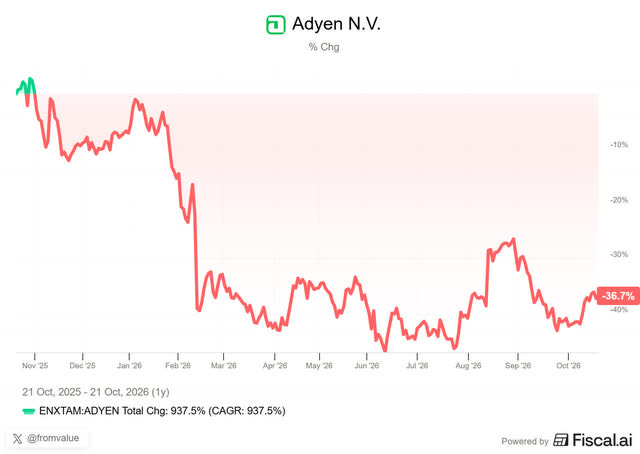
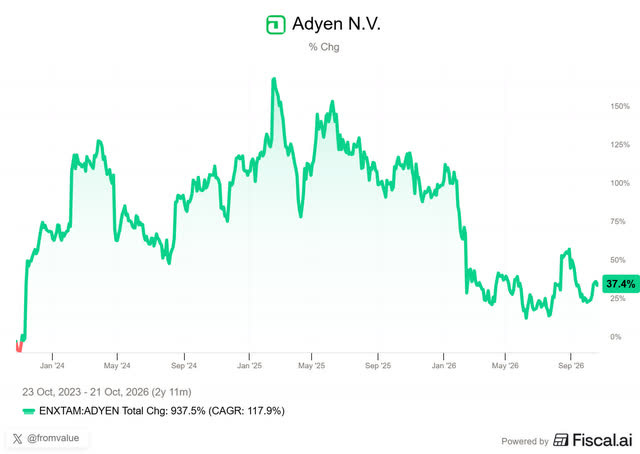
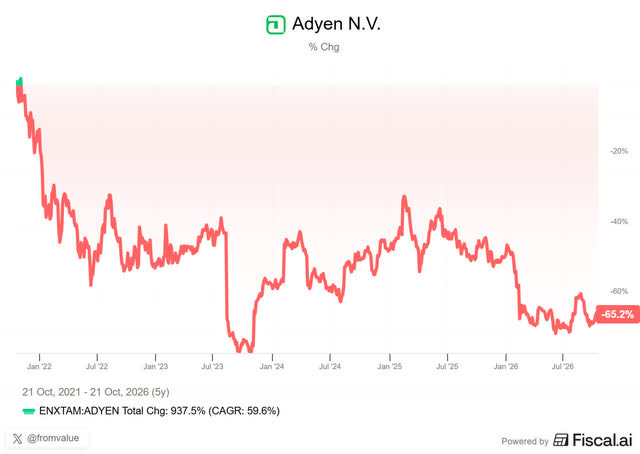
There are basically three reactions you can have in such a situation and the most common should absolutely be avoided. Let’s start with that one.
Many investors look only at the stock price and conclude their investment thesis was wrong. But the stock price alone is a poor measure for that conclusion.
Many things can happen in the stock market. Very often, over stretches of time, sentiment is much more important than the fundamentals. That’s often reflected in valuations that contract simply because the market mood shifts. And that happened to Adyen.
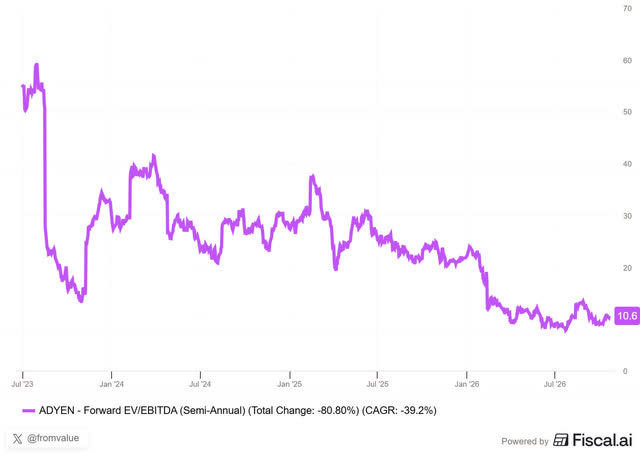
Its valuation has dropped 80% in the last three years. Wow.
So, what are the two other possible behaviors?
Well, simple. The first is to do nothing. While often, that’s a good thing, people are very bad at doing nothing when a stock moves against them. You have the feeling you are just lazy or stupid. But also, your money is tied to that stock and maybe you can invest it in something better.
So, the best approach is to do deep research to evaluate if the market had good reasons to sell off the stock or not. That’s exactly what I will do in this article. That information can help you to make an informed decision on what to do: buy more, sell or just hold.
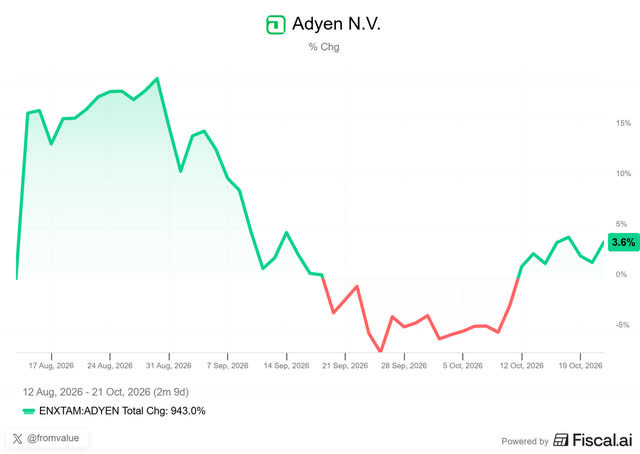
In February, Adyen (ADYEY) dropped 20% because its 2026 guidance came in not even 0.2% below consensus. That’s how ‘efficient’ the market is, y’all. On August 13, the day it reported its H1 2026 results, the stock closed 16.4% higher at about €1,059. But after that initial reaction, the stock sold off again without any real catalyst. It was down 7.3% from the pre-earnings price on September 24. Right now, it’s up a paltry 3.6%.
I was very happy to see co-founder and co-CEO Pieter van der Does back on the conference call for the Q&A.

And what he said made sense, a lot of sense:
But now consistent growth as we have delivered like the last 3 half year reports, always 21%, that’s the sort of boring numbers which we should bring forward.
In this case, boring is beautiful. Let’s look at those boring numbers.
The Numbers
Net revenue: €1,302.9M, +19% YoY, +21% in constant currency
Processed volume: €803.8B, +24%
EBITDA: €641.5M, +18%, a 49% margin (50% excluding €6M in one-time acquisition costs)
Net income: €544.1M, +13%, EPS €17.18
Free cash flow: €553.4M, +17%, 86% conversion (87% a year ago)
CapEx: €64.1M, 5% of revenue
Take rate: 16.2 bps (16.8 bps in H1 2025)
Q2 was better than Q1. Q1 grew 20% in constant currency, so Q2 must have been around 22%. You could see that in the volume as well. In Q2, new volume was up €88 billion YoY, up from €67 billion in Q1. In-person volume (Adyen’s term for POS, or point-of-sale) grew even faster: 28% to €175.7 billion, now 22% of total volume. Adyen has 838,000 transacting terminals, 27% more than a year ago.
The slight EBITDA miss (0.87%) was a nothingburger. Bad debts and provisions went from €2.6M to €16.1M. Adyen says two isolated events caused this: an impairment on a single counterparty and a clean-up of old merchant accounts that were never closed. Without that extra €13.5M, EBITDA would have beaten expectations.
The 50% EBITDA margin is the same as in H1 2025. H2 is usually stronger. Last year, the EBITDA margin went from 50% in H1 to 55% in H2. These remain very high margins.
Net income grew slower than EBITDA because Adyen earned less interest on its cash at central banks (€95.5M instead of €100.3M) and because depreciation rose 27% with the new data centers (more on those later). Employee costs grew 15%, slower than revenue, even with 249 new hires.
The take rate fell from 0.168% to 0.162%, which shouldn’t surprise anyone who follows Adyen. Each and every time, though, people talk about ‘competition’ as the reason for this. Founder and CEO Pieter Van der Does about competition:
But if you look at our data, you don’t see it back in our data. Our existing merchants give us more and more volume and therefore, come to lower tiers, and that’s the only explanation behind the take rate development.
That’s tiered pricing: the more a merchant processes through Adyen, the lower the price per transaction. I’ve been saying this for years. This is just inherent to this industry. For every other player in this industry, it’s the same game. Even for Visa or Mastercard. Do they suffer from competition as well?
Sometimes, I hear that Adyen is too dependent on the big customers, and that’s why the take rate drops. Nope. Adyen actually depends less on a few big customers. Three years ago, 300 merchants brought in more than 70% of the growth. Now, this has dropped to about 60%.
Let’s look at some more numbers.
Digital: €719.7M, +15% in constant currency, volume €427.9B (+17%)
Unified Commerce: €417.7M, +27% in constant currency, volume €240.9B (+27%)
Platforms: €165.5M, +40% in constant currency, volume €135.0B (+42%)
It’s good to see that Digital is growing faster again. In H2 2025, Digital grew just 10% in constant currency, now 15%. The biggest content and subscription customers shifted more of their payments to Adyen.
Unified Commerce and Platforms grew a bit slower: 27% and 40%, compared to 33% and 49% in H2 2025. Those are still very strong numbers, and together these two pillars now make up almost 45% of revenue.
Adyen now has 486 big customers that use Unified Commerce, so in their stores and online. ‘Big’ means at least €10M on both sides: POS and e-commerce, and more than €50M in total. That’s 19 more than six months ago.
In Platforms, 37 customers process more than €1 billion a year, up from 32 a year ago, and total active business customers grew 51% to 293,000. The growth came from what Adyen calls vertical SaaS. We know this better as VMS, the companies that Constellation Software, Topicus and Chapters Group buy. VMS in financial services and food & beverage were especially strong.
Let’s look at the regional numbers:
North America: €358.1M, +30% in constant currency
EMEA: €722.5M, +15%
APAC: €136.9M, +26% in constant currency
LatAm: €85.3M, +35% in constant currency (43% reported)
The best news was that North America is accelerating. From 20% in H1 2025 to 30% now. As you may know from my Selling Rules, that’s the region I watch most. It’s the biggest payments market in the world and the home market of Stripe, PayPal and Fiserv, just to name a few.
EMEA is the biggest market for Adyen, with 55% of revenue. It showed slower growth, down from 21% to 15%. Interim CFO Hwa Tsao explained that Adyen manages global merchants per customer, not per region. European merchants sell all over the world and US merchants sell into Europe, so the regional split doesn’t tell the full story. And the US investments of the last years are paying off now. That makes sense.
For almost twenty years, Adyen never bought a single company. This year, it bought two in less than two months. Something changed.
When I updated the Quality Score and valuation, I saw a something I had never seen before.
Below:
What changed at Adyen
The take rates
The AI giant that just became a customer
The number that shows how long the growth can go on
My take on Adyen’s famous cash pile
The full Quality Score, the valuation and my verdict.