

Hi Multis
I hope your week was less busy than mine (11 of our companies reported!), but as satisfying as mine. Because deep analysis is what I love the most and so, this was a great week, even if it’s also exhausting. But earnings or no earnings, on Sunday, there’s the Overview Of The Week. So, let’s go.

Articles In The Past Week
Just like in the last few weeks, you got four articles this week, including this one. Here are the three previous ones, all articles that gave my interpretation of the earnings. I compared them against the Selling Rules, updated my Quality Score, and valued them to see whether the stock’s a buy.
The first article this week analyzed Tempus AI’s earnings to decide if the stock is attractive.
In the second article, I did the same for the first Potential Multibaggers stock ever: Shopify, on May 2, 2017, at a split-adjusted $7.78. You can find here what I mean with Shopify’s new front door.
Yesterday, you got the Mercado Libre analysis. The stock has not done great, but does that mean it’s a buy? You can find the answer here.
Memes Of The Week
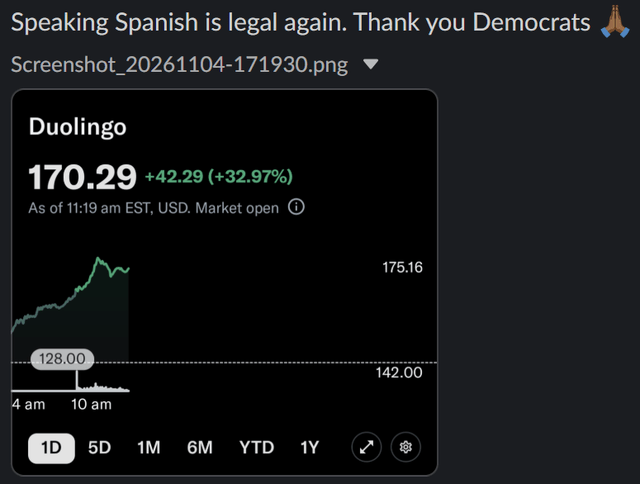
Our very own Potential Multibaggers Meme King proved again why he deserves that title. Flo posted this after Duolingo shot up this week.
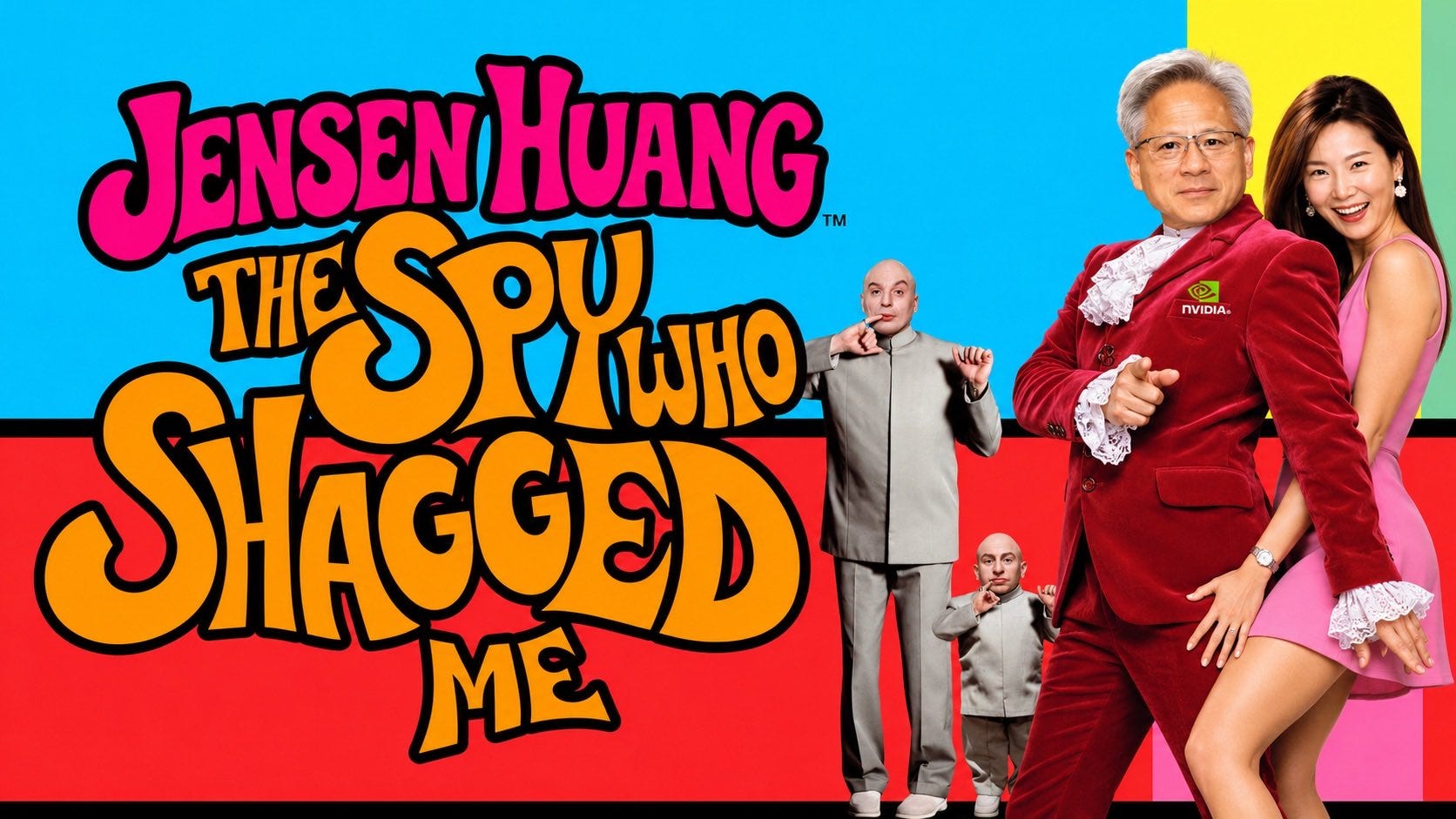
This week, the New York Times reported that Nvidia founder and CEO Jensen Huang would have had an affair with a girl who may be a Chinese spy. More later in this article, but there are already quite a few memes about it. This is one of the best.
Interesting Podcasts Or Books
This week, I started reading an 800-page book. I’m at page 210, but I can already say that I really love the book. It’s a biography of Alan Greenspan, the legendary Fed Chairman from 1987 to 2006. He passed away earlier this year, at the age of 100.
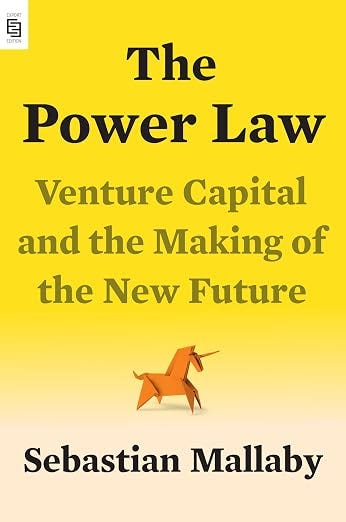
The book is written by Sebastian Mallaby, the author of another great book I read, The Power Law, a history of venture capital in Silicon Valley. I highly recommend that as well.

The book on Greenspan is great if you are interested in, or want to learn about, macroeconomic thinking, the financial system, and the different opinions on it. Even if that may sound a bit boring, I thoroughly enjoy it because Sebastian Mallaby is a fantastic author and he proves that again in this book.
The markets in the past week
Sometimes, the stock market doesn’t have any strong moves up or down. This week was not one of those weeks. The volatility was pretty crazy.
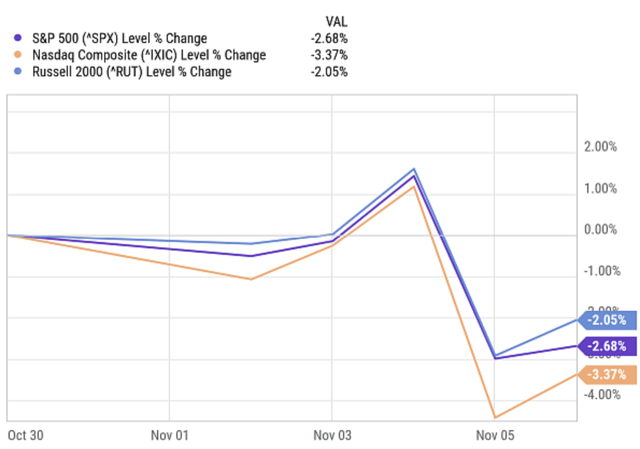
As you can see, the Russell 2000 lost 2.05%, the S&P 500 dropped 2.68% and the Nasdaq was down 3.37%. The crazy thing is that Thursday was the only day that was down so much. Wednesday evening, all indexes were up more than 1% and on Friday, they were green again. But that one-day drop was harsh.
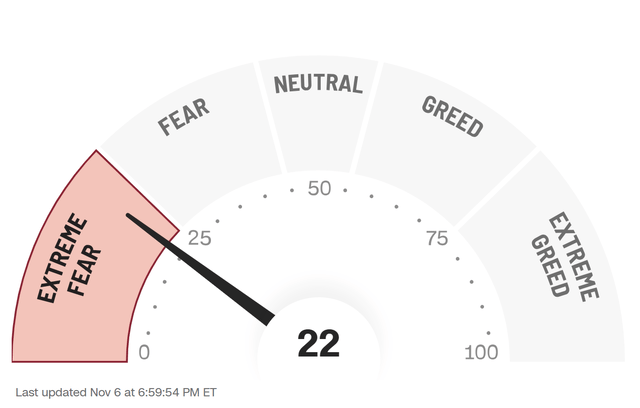
The Greed & Fear Index dropped from FEAR to EXTREME FEAR.
Quick Facts
1. The Blue Wave
Last week, I already wrote about the midterm elections, and the result has become a blue wave, as it’s being called.
I know a lot of people invest based on their political ideas. I’m not one of those people. Why not? There are several reasons.
First, you have to understand that the market has a much bigger problem with uncertainty than with certainty. Even if the news is not great, there is certainty and markets can deal with that.
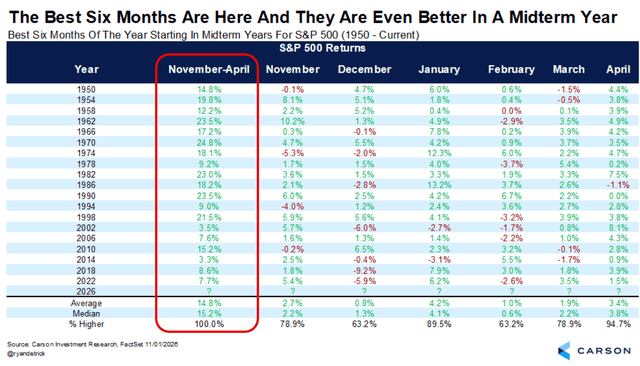
Second, I showed you last week that the six months after the midterms are usually very good. Actually, not usually: always. Since 1950, every single November-April period after the midterms has been positive. That has not changed. I repeat the chart I shared last week. Source
I know some will think this time is different because there’s a Republican President and a Democratic Congress. But look at this stat.
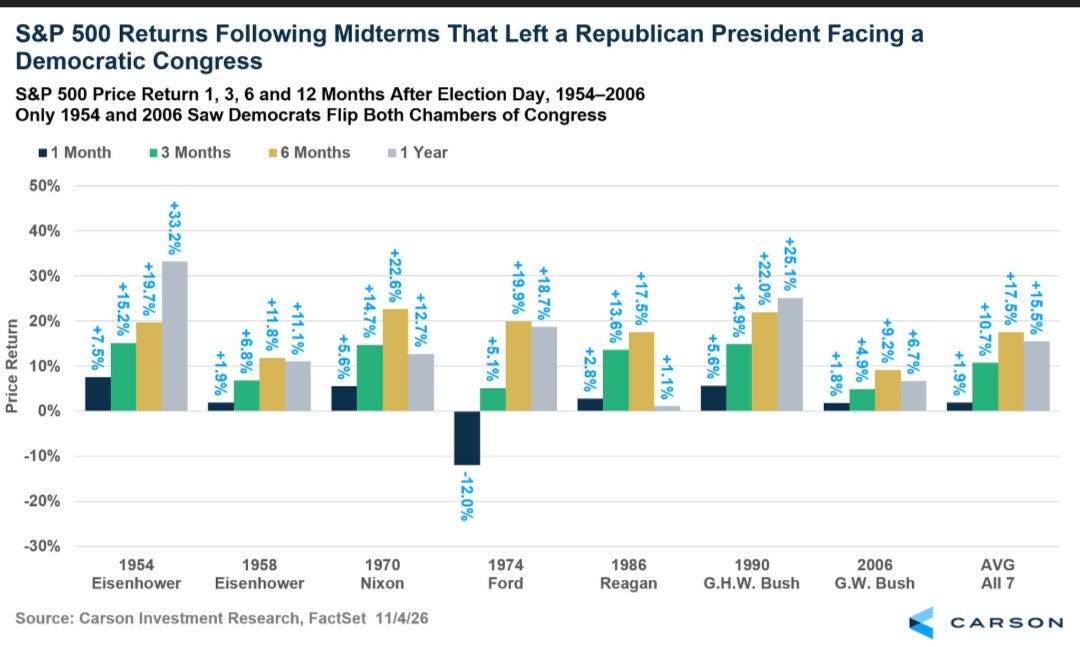
In the last bars, you can see that the stock market was up 17.5% on average six months later and it never dropped.
Of course, the sample size is small and there are no guarantees in investing. I just want to show you that you shouldn’t mix investing and politics.
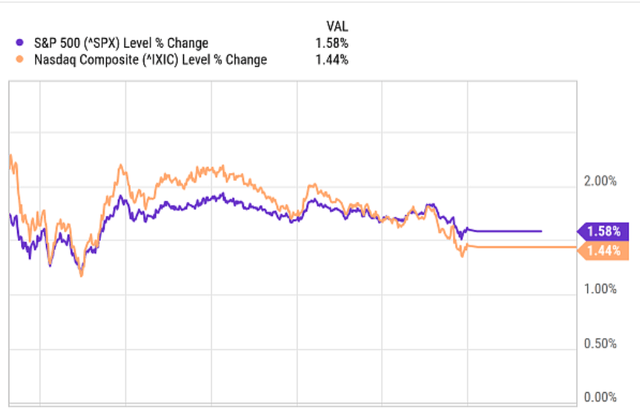
The stock market’s reaction to the elections was good. If you look at the indexes on Wednesday, they did well.
But on Thursday, there was a big sell-off.
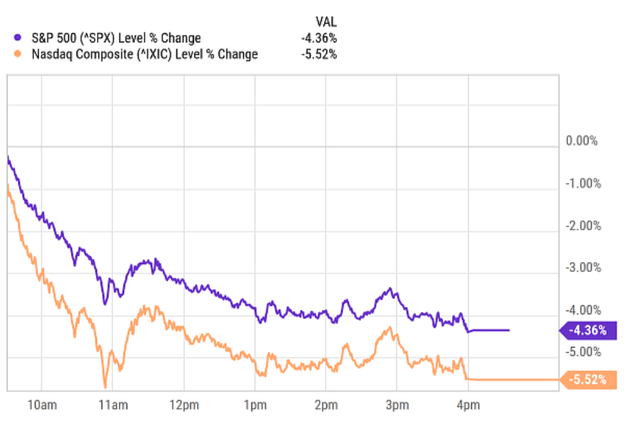
Of course, for people who want to put politics at the center of everything, it’s very, very convenient that this sell-off happened just two days after the elections. They will push their stories, for example, the stop on AI data centers that some Democrats have talked about.
Now, don’t get me wrong. I won’t brush this worry aside, because it could slow down AI spending. But the fact that the market first reacted positively to the elections tells me Thursday wasn’t caused by the elections, even if that’s the story you hear everywhere. It may have played a role, but something else is definitely at play. You can’t have the market rally first after the elections and then crash on the same event.
Numerous rumors are circulating about funds blowing up, and yep, the same name keeps coming up: Leopold Aschenbrenner. So far, these are only rumors. But the news about funds has not been great. On Thursday, Walleye Capital, a $17 billion hedge fund, told its investors it would restructure its stock-picking business and return some capital. That probably has a much bigger influence on the market than the elections. If such a fund blows up, it puts huge selling pressure on the market.
You have to know that these funds use leverage (investing with borrowed money). If something goes against their investments, for example, a sell-off caused by another fund, their losses are much bigger because they are leveraged.
That’s why I always say that as an individual investor, I would not use leverage. Now, I know that some Multis use it at the margins, meaning something like 10% leverage. I think that’s okay. But when Leopold Aschenbrenner’s fund blew up in July, it ran about 4x leverage. That’s just a disaster waiting to happen.
Bloomberg gave this overview of the damage:
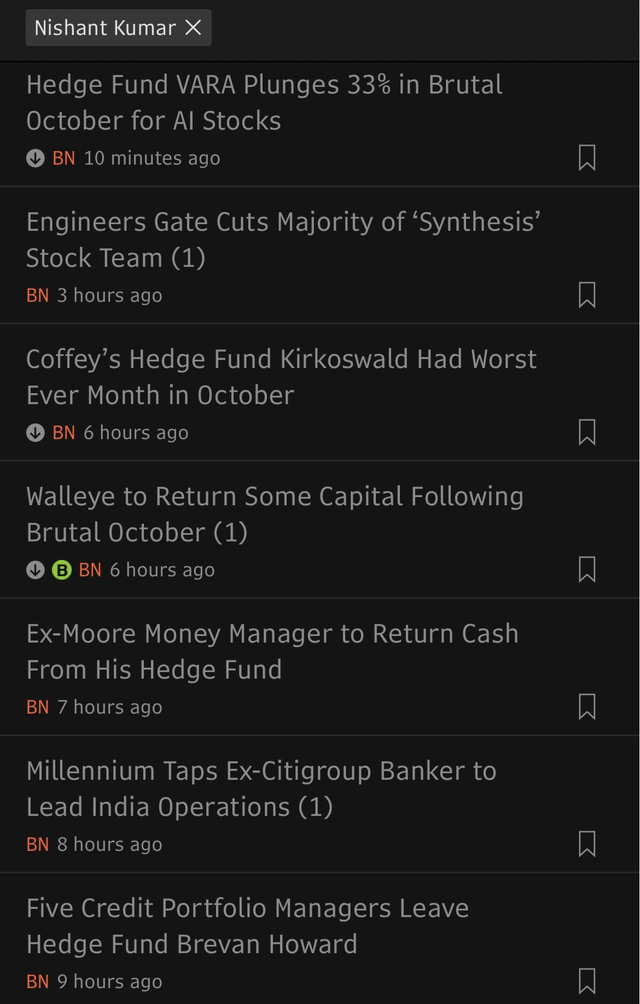
Both The Wall Street Journal and Bloomberg confirmed this was already happening before Thursday. That day only made it worse. Obviously, as media, they have to tell the story that it’s because of politics, but they weaken their own stories of funds blowing up. The stories the mainstream media give you are often not more than that: stories. They all look at each other and copy eachother’s work. Because there is little diversity of thought, you come to believe this is the truth, even if they also bring other news (like funds blowing up here).
But let’s look at this from an opportunity standpoint. Here’s a list of every date in history when the S&P 500 was down -4%, and the Nasdaq -6%.
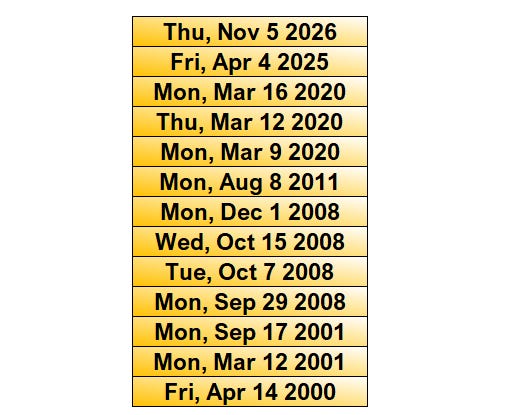
If there’s one common theme, it’s simple: almost all happened near the bottom, at most a few months from the bottom, but often within days. Again, this is no math, so don’t ascribe too much value to this, but it’s something to counter the fear you are definitely exposed to in this market.
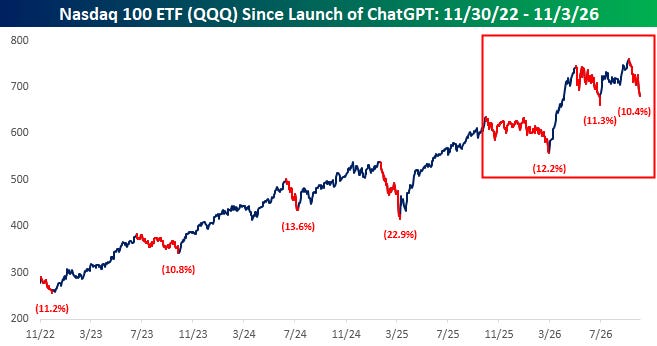
By the way, this is the 7th time since ChatGPT launched in November 2022 that the Nasdaq has been down more than 10%. Over the last year, the Nasdaq has been more down 10% than it has gone up, but the index is still up.
2. Not the Dotcom Bubble
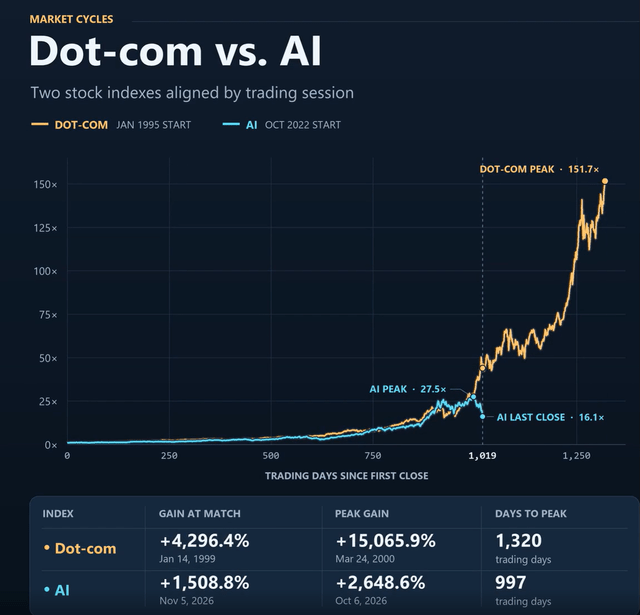
I have an internal rule that says anyone who says this AI boom is like the dotcom bubble either wasn't there or has forgotten what it was like. Sure, there are similarities, but that doesn’t mean they are the same. And there are some things I don’t like, like the circular financing, the off-balance-sheet debt, and the huge commitments for chips for years to come, to name a few. But unlike the dotcom bubble, AI shows real productivity gains. The value is expressed in time saved. During the dotcom bubble, “eyeballs” (meaning visits to the site) were the main metric. That’s something completely different.
On top of that, everyone seems to be forgetting that there was a huge blow-off top from January 1999 to March 2000. You can see that in this graph.
3. Value Beats Growth This Year
In 2026, for the first time since 2022, value does better than growth. Right now, value is up 24.3% on average, while growth is down 6.4%.
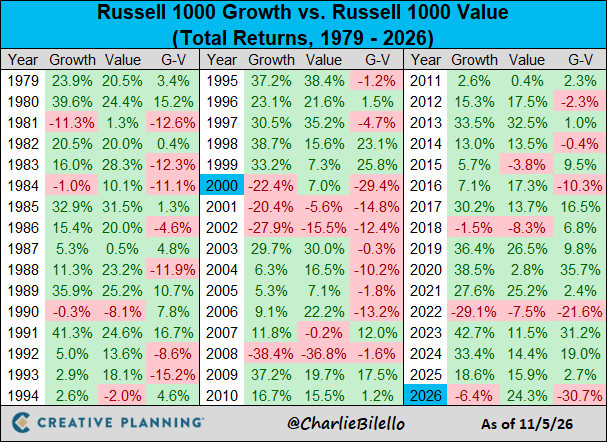
If this holds, it would be the biggest difference between value and growth since at least 1979, even bigger than the difference of 29.4% in 2000, when the dotcom bubble burst.
Maybe you have felt that in your investments as well. Thursday, especially. But these are cycles.
I let ChatGPT calculate the returns for five-year periods, on average and in aggregate. This is the result.
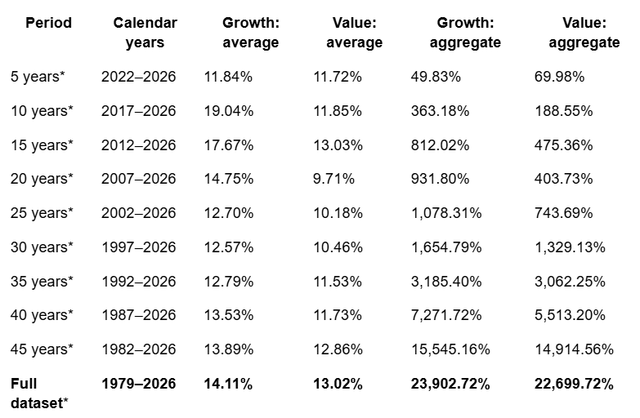
Before we go on, let me first explain something, because it may look weird. If you look at the average over the last five years, growth seems to outperform, but not in aggregate. The reason is that the average of the number is not the same as the aggregate. For example, here are the returns over the last five years, starting with $100.
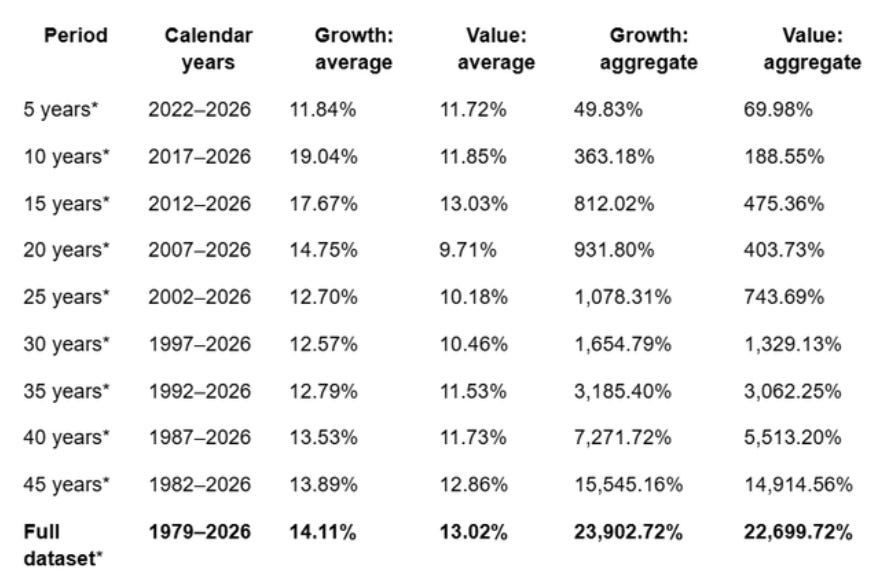
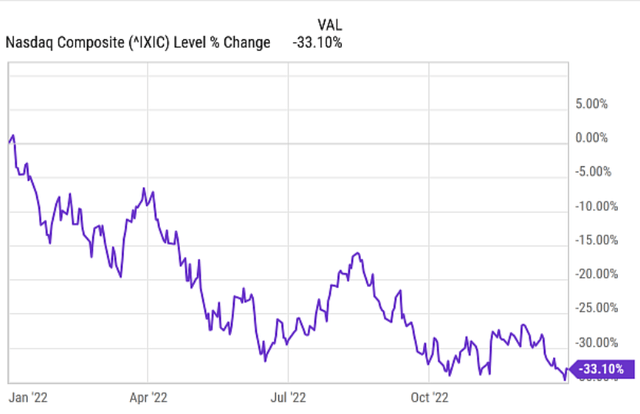
Because value avoided that deep drop in 2022, it didn’t need as much average return to still outperform. The start really matters here: January 1, 2022, just before the 2022 Nasdaq crash. This is what the Nasdaq did from January 1 to December 31 in 2022.
But over 10 years, 15 years, 20 years and 25 years, growth wins.
4. Jensen Huang: From China, With Love.
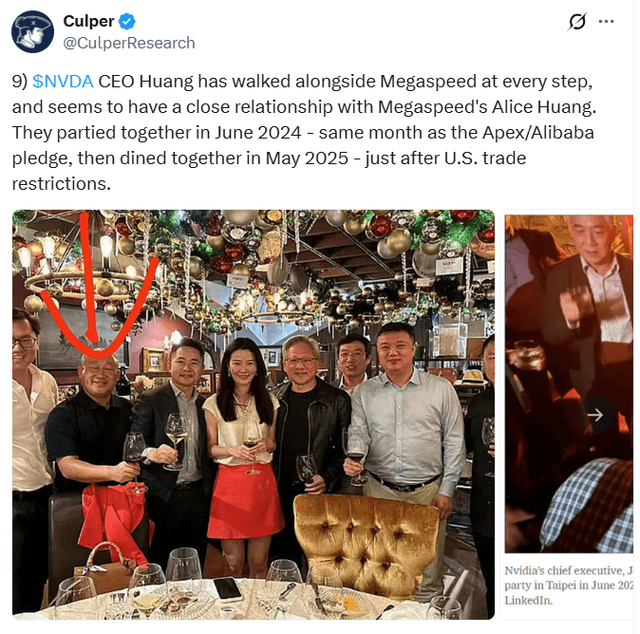
The juiciest story of the week was that Nvidia founder and CEO Jensen Huang had an affair with a girl who is believed to be a Chinese spy. Her name is Alice Huang. She’s not family, just to be clear.

The New York Times and The Financial Times, which first reported the news, say an internal memo from intelligence services exists. This story has such a high James Bond level.
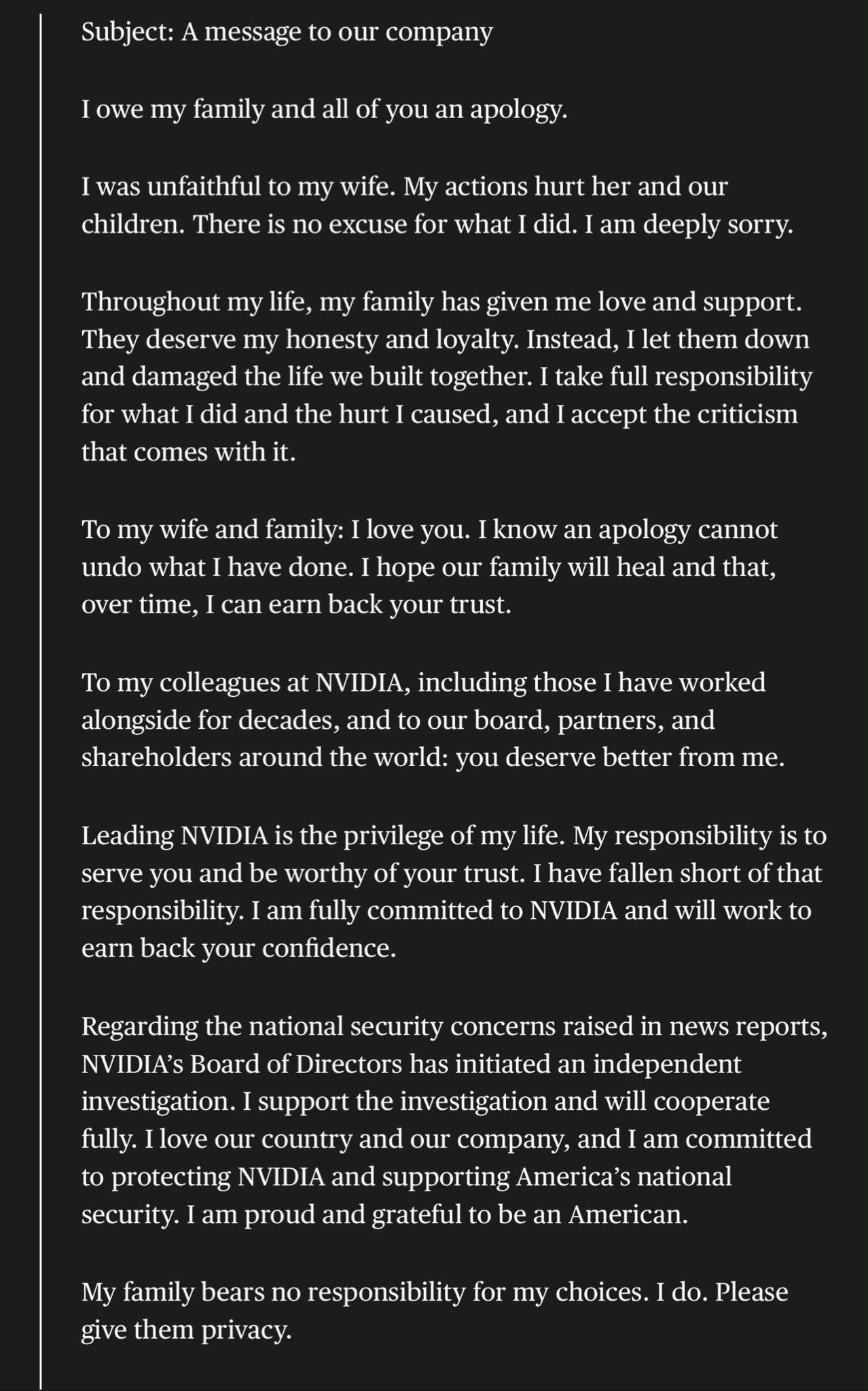
Meanwhile, Jensen Huang has admitted to being unfaithful to his wife and apologized to her and to their children. He also said he’d take full responsibility for this and he failed in his responsibilities towards the company’s employees, the Board and shareholders. This is what he wrote.
Nvidia has opened an official investigation, but it also said it had no reason to believe Jensen Huang shared company secrets or put national security at risk.
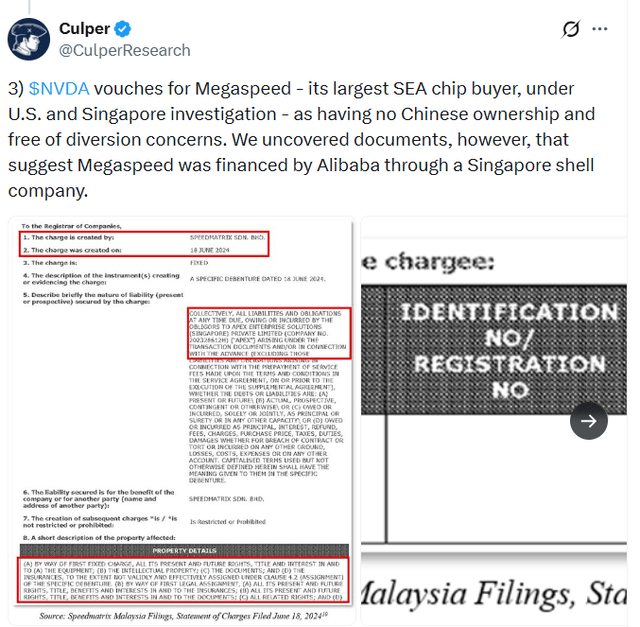
But it’s more complicated than you might think. It’s not just a matter of an unfaithful husband and some random Chinese spy. Alice Huang, the alleged spy, is an executive at Megaspeed, the biggest Southeast Asian customer of Nvidia. Megaspeed was already under investigation. This post from half a year ago was shared multiple times on X.
And this:
I think Jensen Huang will remain Nvidia’s CEO, but if the pressure gets too big, he might step back. In that case, just like Larry Page and Sergey Brin still lead Google and Jeff Bezos leads Amazon, he will continue to lead Nvidia, even if it’s behind the scenes.
The bigger impact could be for Nvidia. Jensen Huang has spent months convincing US politicians to ease the export restrictions on Nvidia’s advanced AI chips to China. Of course, some will say he did this because of his affair with Alice Huang, but that’s nonsense. Nvidia has big commercial incentives to ask for the restrictions to be removed or as loose as possible. It’s a gigantic market. But of course, AI also has great power. You can do a lot with it and in the wrong hands, it could be used against the US.
As you may know, I used to work in the Belgian Federal Parliament. When I see this drama unfold, my first reaction is to wonder who leaked the information to The Wall Street Journal and The Financial Times. That person or department probably did this with a purpose in mind. Probably, it’s someone who is annoyed that Jensen Huang has succeeded in appeasing President Trump’s attitude toward export controls of AI chips to China. It’s a classical trick in politics and often, it succeeds. I think this might be the case here as well. So, yes, this might hurt Nvidia’s business. But at the same time, I don’t think it’s a real thesis breaker.
I have a sizeable Nvidia position but it’s not one of my top holdings. What I will do with my position? Probably nothing.
This once more underlines why diversification is so powerful. You can study a company for a thousand hours and more and still something could happen that you could never foresee.
Do you find this valuable?
If so, there’s even more value behind the paywall.
Stop doubting.