

Hi Multis
What a market...
On Tuesday, Shopify (SHOP) reported its Q3 2026 earnings and the stock dropped like a rocket. It was down 20% shortly after the announcement, but it went back to -6% during the day and ended the day about 10% down, where it still is now, after it went to only -3% at a certain moment.
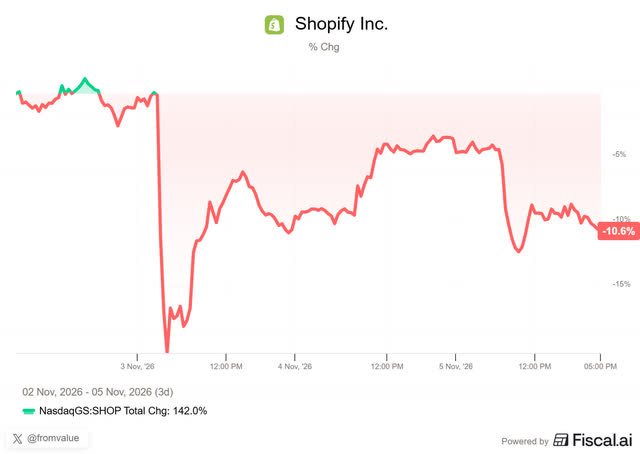
So, what did the numbers say? Let’s check.

The Numbers
Revenue: $3.74B, +32% YoY
Merchant Solutions: $2.91B, +35%.
Subscription Solutions: $836M, +20%.
MRR: $230M, +19%, accelerating from 16% in Q1.
GMV (gross merchandise volume, the dollar sum of everything sold on the platform): $119.1B, +29% (+30% in constant currency).
GPV penetration (Gross Payment Volume, penetration is how much of GMV is paid through Shopify Payments): more than 68%, up from 65% YoY.
Gross profit: $1.78B, +28%; gross margin of 47.6%, vs 48.9% YoY
Operating income: $568M, +66%; operating margin of 15.2%, vs 12.1% in Q3 2025
Free cash flow: $816M, a 22% FCF margin, vs 18% a year ago.
Buybacks: $562M, with diluted shares down to 1.291B from 1.313B a year ago.
Guidance: Q4 revenue growth in the low 30s%, gross profit growth in the high 20s%, operating expenses at 29-30% of revenue and an FCF margin in line with Q4 2025 (19%).
I summarized the most important numbers in this image.
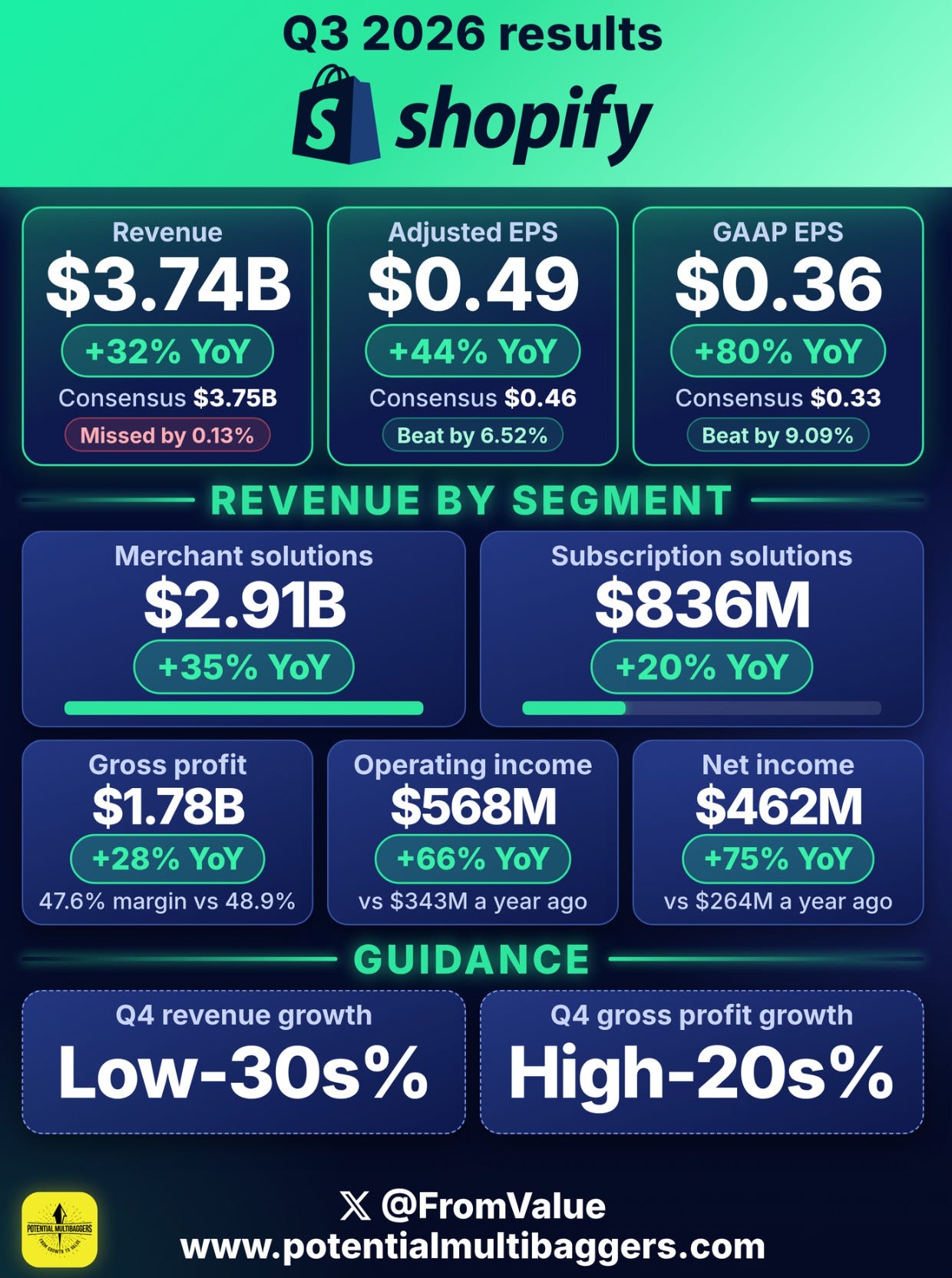
There was a tiny miss on revenue. Well, it depends, some gave 3.74B and then revenue was in line. But this probably caused the sell-off.
Some Facts
Here, I sum up some short facts I liked. They are not worth spending too many words on, but I like mentioning them so you see how the company is doing.
Shopify’s merchants sold almost as much in Q3 as in all of 2020, the pandemic year. The most impressive part is that it’s not even the strongest quarter, since Q4 is always the best for retailers.
Over the last three years, Shopify’s US merchants grew online sales by 23% per year, while US e-commerce as a whole grew by only 8% per year. In Europe, the number was 37% versus 8%. That shows that Shopify merchants are a very young and growing part of the economy.
Three years ago, Shopify merchants were responsible for about a fifth of all additional e-commerce sales in the US and nearly a quarter in Europe. Since the start of 2025, that’s nearly half in the US and more than 40% in Europe. Shopify’s total share of US e-commerce is now a little over 14%.
During the quarter, Shopify paid about $100 million for the domain Shop(.)com. President Harley Finkelstein explained why the company paid such a high price:
Look, in the physical retail world, location, location, location matters, we think the same thing that applies online as well and we think Shop(.)com is an incredible prime address for us.
Shop moved there from Shop(.)app, and according to Harley, traffic to Shop is now growing faster on the web than in the app.
Sometimes, people still see as only for mom-and-pop online stores, but merchants have become bigger. The group selling $2M to $25M per year added the most gross merchandise volume and at the same time, that group is growing. It shows that Shopify is fertile ground for many new brands to grow.
But while that group added most GMV, there are other strong growth factors. Offline GMV grew 30%, and 55% of the merchants that added Shopify’s point-of-sale in Q3 were new to Shopify. That’s impressive. It means that more and more physical retailers come to Shopify directly, not through an online store first. For example, MAC Cosmetics opened 84 locations on Shopify just 120 days after becoming a customer.
The advantage Shopify gives is that you give a physical store the advantage of an online store. If you shop online, the store knows who you are, your preferences, what you bought and so on. In an offline Shopify-powered store, you also get that experience.
And Shopify’s merchants keep getting bigger. Merchants with $2 million to $25 million in sales added the most GMV. Merchants above $25 million grew the fastest, but from a smaller base. That also explains why subscription revenue grew slower than GMV. The bigger merchants get, the more Shopify earns from their payments compared to their subscriptions.
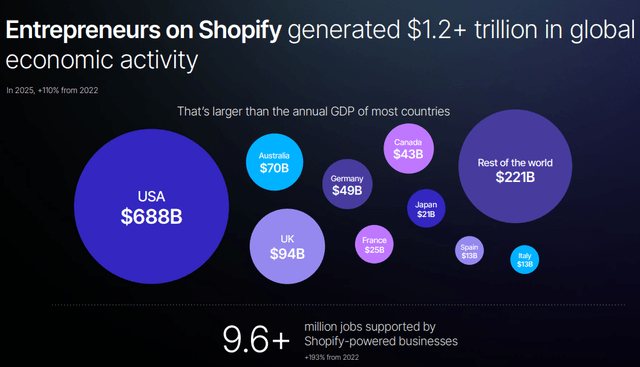
All together, Shopify merchants have had an impact of $1.2T and more than 9.6 million jobs come from Shopify-powered businesses.
This was all interesting, but analysts mainly wanted to talk about one subject: AI agents.
The New Front Door
So, a tiny revenue miss probably caused the drop. If that were all, this would be a short article, haha.
Below: the new front door, how and how much Shopify earns with AI agents shopping, how small merchants (and Shopify) win in this new world, the biggest product update in Shopify’s 20-year history, what Benjamin Graham, the father of value investing, would say about Shopify’s price today, the updated Quality Score and the full valuation. Is it overvalued, fairly valued or undervalued? The answer’s below the line.
I made Shopify a Potential Multibagger at a (split-adjusted) $7.78 in 2017. Don’t want to miss opportunities like that anymore?