

Hi Multis
Tempus AI (TEM) reported its Q3 2026 results on Monday morning, before the market opened.

If you followed the stock that day, you saw a market that couldn’t make up its mind. TEM opened at $74.43, dropped to $70.30, almost 3% below Friday’s close, and then climbed to $83.42, more than 15% up. It closed at $78.48, up 8.7%. That’s a swing of almost 19% between the low and the high, in a single session. The market is always very consistent, as we know, haha.
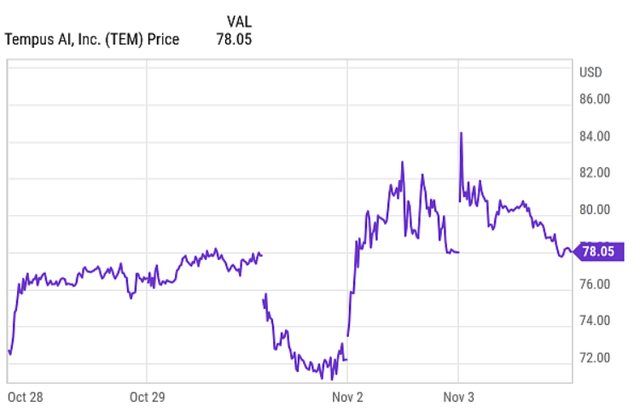
The crazy thing is that the stock is down 12% from a year ago, but at the same time, it’s up 88% since the end of July.
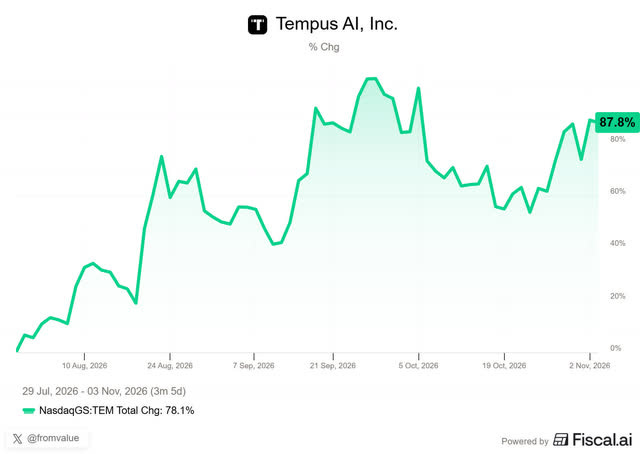
I think it’s pretty safe to say that Tempus is a volatile stock, haha.
Let’s look at the numbers.
The Numbers
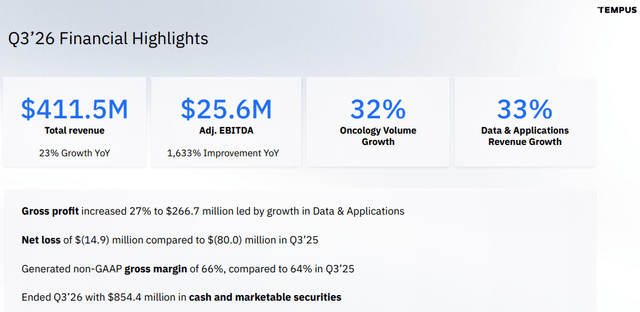
Revenue: $411.5M, +23% YoY.
Diagnostics: $303.5M, +20%, with Oncology +28% on 32% volume growth and Hereditary +3%.
Data and Applications: $108.1M, +33%, accelerating from 28% in Q2.
MRD volume: about 12,000 tests, +300% YoY.
Adjusted EBITDA: $25.6M, versus $1.5M in Q3 2025.
GAAP net loss: -$14.9M, versus -$80.0M a year ago.
Cash from operations: +$9.2M, versus -$7.5M in Q2 2026.
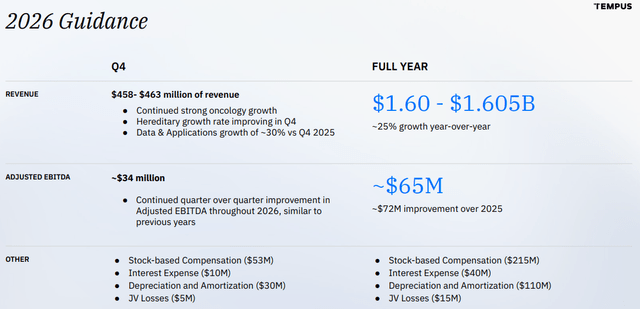
Guidance: full-year revenue of $1.60-1.605B (about 25% growth), up from $1.595-1.605B. Adjusted EBITDA $65M.
This is the overview Tempus gives in its earnings slide deck.
The Turn
I want to look a bit more into the financials and I take this quote from founder and CEO Eric Lefkofsky (my bold):
We generated $25.6 million in Adjusted EBITDA and ended the quarter with $854.4 million in cash and marketable securities. We had long suspected that with gross profit dollar growth outpacing our investments, we would eventually turn the corner and be able to generate meaningful EBITDA. This quarter, we made the turn.
Adjusted EBITDA jumped from $1.5M to $25.6M. At the same time, Tempus still had an operating loss of $56.9M on a GAAP basis. The biggest difference is SBC (stock-based compensation), which accounted for $50.8M. The rest comes from amortization from the acquisitions. Those are both non-cash costs, but of course, as a shareholder, SBC dilutes your position.
The GAAP loss of $14.9M is also misleading. It would be a bigger loss on a GAAP basis. But companies have to book stakes they hold in other companies in the GAAP numbers. In this case, $42.8M came from paper gains on Tempus’ shares in Personalis and Recursion.
That’s why I think operating cash flow is best to look at, as it shows the money generated from the company’s core operations. It came in at $9.2M, up from -$7.5M in Q2. That’s why Eric Lefkofsky’s “We made the turn” makes sense.
You can see the same in the operating leverage the company is using. Lefkofsky already referred to that as well. Non-GAAP gross profit (excluding SBC) grew by $58.6M compared to Q3 2025. Non-GAAP operating expenses grew by $35.5M. In other words, of every extra dollar of gross profit, Tempus reinvested about 60 cents and about 40 cents was not spent. That’s close to the formula CFO Jim Rogers explained on the call:
We are still relatively early days in a lot of the offerings, so we have had this perspective of reinvesting two-thirds or roughly two-thirds of any incremental gross profit dollars that we generate back in the business, and then letting a third drop down to the bottom line
Obviously with Personalis coming on board, we are already going to invest a lot in MRD. We will utilize some of that reinvestment dollars to absorb the burn from Personalis.
But then after another couple years, then that flips, right? Then you are generating meaningful gross profit dollars such that you really only need to invest a third, and you can let two-thirds drop down to the bottom line.
I like the clear plan.
So the turn is there. But there’s a lot more.
Below: the change that’s already decided and will make 2027 much better, why Tempus sells much less of its fastest-growing product than it could (for now), the shift in how doctors test that is a strong tailwind for Tempus’ future, what makes the data customers “crazy sticky” in the CEO’s own words, the one part of this company I really don’t like, the updated Quality Score, the valuation and my verdict.
Up 88% since July and still down 12% in a year: buy, hold or sell?
Don’t miss these valuable insights anymore.