

Hi Multis
I hope your week was as much fun as mine.
It was not that mine was anything special, but that’s what I loved about it. Last week was my birthday, and I traveled to Bonn for a conference, which I really liked too. But just being at home and writing articles still feels like such a great week for me. After all these years, I still enjoy this so much, especially when I have a week where I write a bit less, like last week. This week, therefore, you got more articles than usual.

Articles In The Past Week
This is the fifth article this week. Let’s check the four previous ones.
I had already promised you the first article in last week’s Overview Of The Week. It was the second article in the Rocket Lab series.
This week, I sold a position in my portfolio. Not a Potential Multibagger. I added to my positions in the three most recent Potential Multibaggers picks. You can read about the position I sold and why here.
In the third article, we looked at Topicus. Robin Van Poelje stepped down as the CEO. Should you be worried about that? You can find the answer in this article.
The fourth article was about Cloudflare. The stock has shot up a lot. In this article, you can find what I think about this.
Memes Of The Week
No memes this week.
Interesting Podcasts Or Books
I listened to several podcast episodes in Dutch this week, but none in English. For the people who understand Dutch, I listened to two episodes of Geld Is Al Wat Telt, episodes 40 and 41, with two people I know: Tom Simonts and Tim Nijsmans.
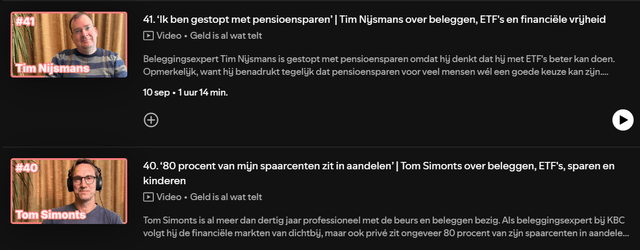
You can find the podcast here.
But for Multis who are better in English, I have a tip as well. I have not listened yet, but it will be the first thing I’ll listen to in the upcoming week. It was only released today.
David Senra is a good interviewer and he interviews Alexander Wang, who created Meta’s Muse, which is going viral. You can listen to the episode here.
And there’s a second episode I put on my list to listen in the upcoming week after I saw this post on X. It was also only released today.


Michael Moritz is a living legend, so I’m definitely listening. You can find the episode here.
The markets in the past week
So, what did the markets do this week? Let’s have a look.
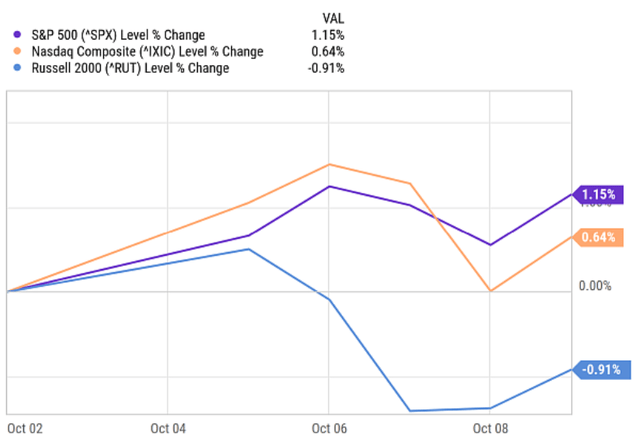
A strange pattern this week, with the Russell 2000 down 0.91%, the Nasdaq up 0.64% and the S&P 500 up 1.15%.
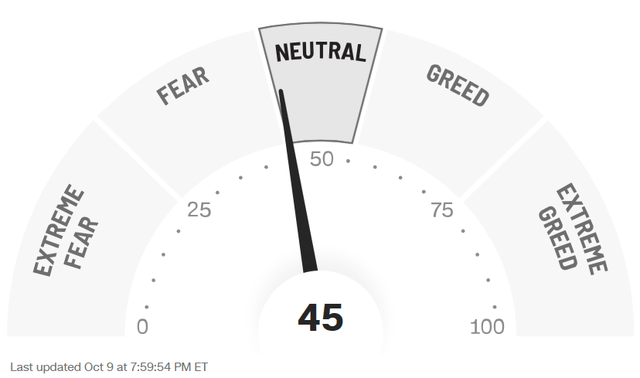
The Greed & Fear Index popped from FEAR last week at 31 last week to 45 and Neutral.
Quick Facts
1. Should You Be Worried About Interest Rates?
It's the question I've gotten most often in the last few weeks: “Kris, shouldn’t we be worried about the interest rates?”
Well, no. At least not yet. As I wrote in the Overview Of The Week a few weeks ago after the Fed raised the interest rate:
Overall, the markets don’t seem to really care too much. The reason is that the earnings expectations are high.
When it comes to interest rates, I think you should do what you should do in every situation: put things in context. If the economy and especially the profits of companies (so not just government spending) grow fast enough, more than the interest, then value is created.
The estimate for GDP growth for Q3 is 5.1%. Now, that’s just pure growth. If you add inflation, you get a nominal growth of more than 8%, which is the number to weigh against the interest rate. So, right now, I don’t think the interest rate hikes are a problem for the economy or investing.
This week, I saw this chart. It shows US real yields: the 10-year Treasury yield minus headline CPI (Consumer Price Index, or in other words, inflation).
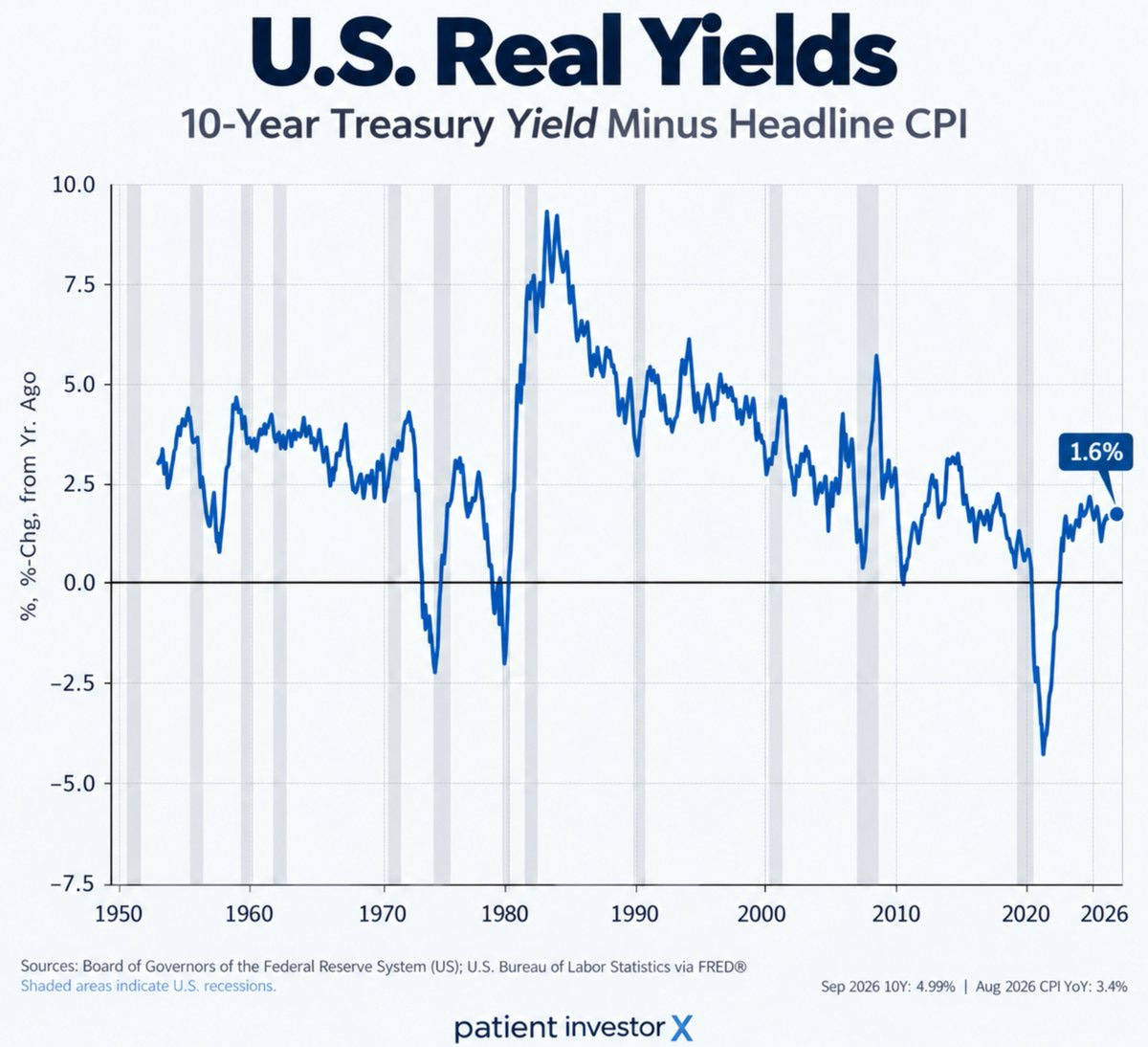
With the 10-year yield at 4.99% in September and inflation (CPI) at 3.4% year-over-year in August, real yields are only around 1.6%. As you can see, that’s well below the historical peaks of the early 1980s and below the average for 1950-2026.
Of course, as always, if something goes wrong, things can always change fast. But for now, I’m not yet worried about the interest rates.
2. 134 S&P 500 Stocks Down 40% Or More
Fiscal ai shared that 134 stocks in the S&P 500 are now in a 40% drawdown or worse versus their all-time high.
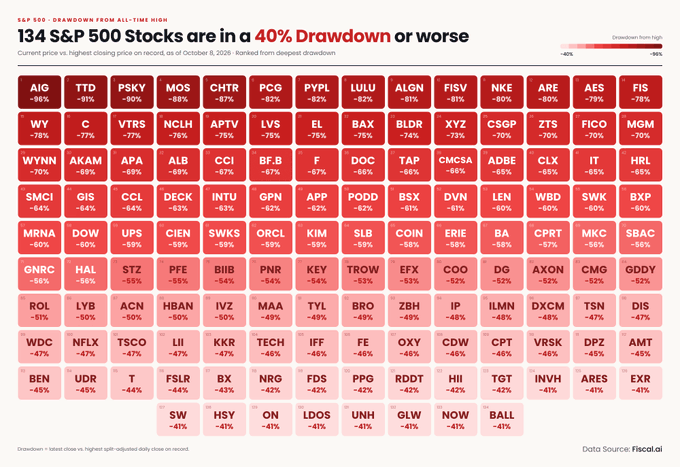
AIG is at the bottom of the list with -96%. The Trade Desk (TTD) is second with -91%. Ouch... AppLovin (APP) is there as well, just like Adobe at -65%, Axon (AXON) at -52% and Netflix at -47%. Now, it has to be said that this is versus the all-time highs. Those were sometimes unreasonably high. Still, it shows there are always opportunities. It’s always important to distinguish between a broken stock and a broken company.
3. Burry’s Crash Calls
I have repeated this so many times, but I can’t repeat it enough: Pessimism sounds smart, optimism makes you money.
Michael Burry is famous for The Big Short. Since then, for 18 long years, he has been calling a crash constantly. Shay Boloor shared this Burry Crash Tracker.
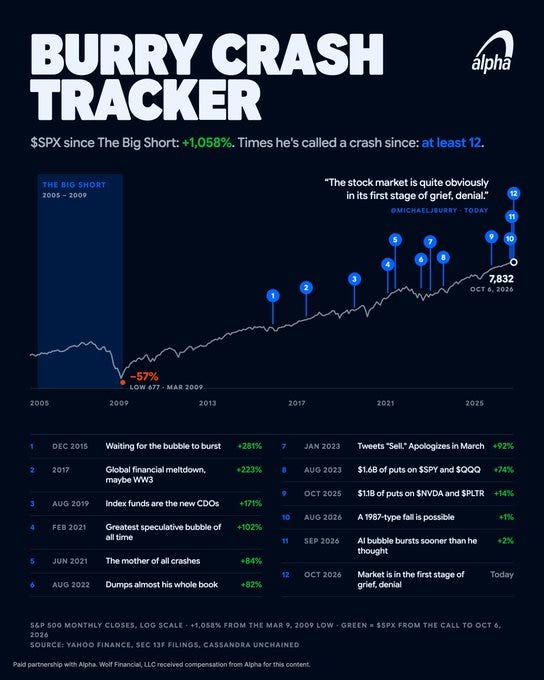
The S&P 500 is up 1,058% from the March 2009 low. The first call on the tracker: December 2015, “Waiting for the bubble to burst.“ Since then, the S&P 500 is up 281% and the Nasdaq even 430%.
He released his latest bearish call this week: “The stock market is quite obviously in its first stage of grief, denial.”
But when a crash comes, whenever that is, people will say: “He was right!” A broken clock is much better than this... It’s right twice a day. Burry has been wrong for at least a decade.
The problem is human psychology. If someone says everything is OK, they sound like a snake oil salesman. If someone warns you, he must be doing it to warn his fellow human being, right? That system is deeply ingrained in our human psychology. But many people know that negativity sells. Negative headlines get three times as many clicks as positive ones. That’s why you are worried about the “AI trade” about interest rates, about oil, the war in Ukraine, tariffs and so many other things.
But if you zoom out, as a species, we have done incredible. Everyone who says otherwise hasn't lived long enough or sees the past distorted. And for the stock market, the same goes.
I shared that I became 50 last week. I looked at the return from the day I was born until now.
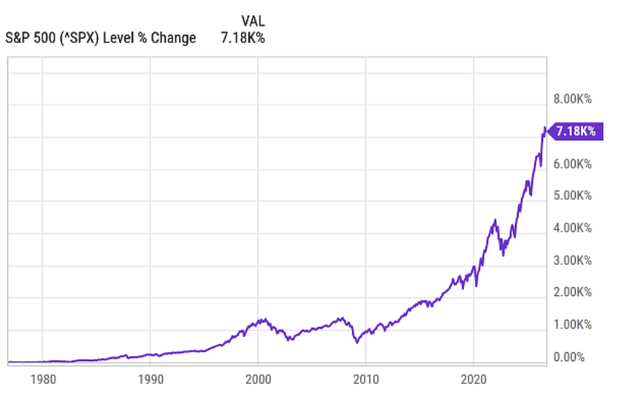
Up 7,180% or a CAGR (compound annual growth rate) of about 9%. That means that every $10K invested in the stock market became $718,000. With reinvested dividends, that would have been even much more.
That includes Black Monday in 1987, the Dotcom crash of the early 2000s, the Great Financial Crisis of 2008-2009, COVID, the interest rate crash of 2022 and much more.
The stock market was down more than 10% at least 25 times. It was down more than 20% at least 7 times, 30% at least 3 times, 40% twice, and once (during the Big Financial Crisis) more than 50%.
Over the long term, investing just works, no matter what the prophets of doom tell you.
If you are a free reader, it stops here for you.
You miss a lot.
In this article, for example, whether AI capex is really about to peak, why cheaper AI tokens are good news, not bad news, the two stocks I added to my radar this week, the deal that could bring one of my picks to a totally different scale, and so much more. Don't want to miss anything?