

Hi Multis
On Monday, September 14, Topicus (TOI:CA) (TOITF) sent out a short press release. Robin van Poelje retires as CEO on October 1, “for personal reasons.” After Mark Leonard, he’s the second fantastic CEO in the Constellation Software universe to step down. In my Quality Score, he got a 10/10 for management quality. So, I was pretty shocked that this happened and I needed some time to think about it.
I also still owed you an article about the Topicus Q2 2026 results. So, we’ll start with the numbers, then the situation with Robin van Poelje stepping down. As usual, we will also update The Selling Rules, the Quality Score and the valuation.

The Numbers
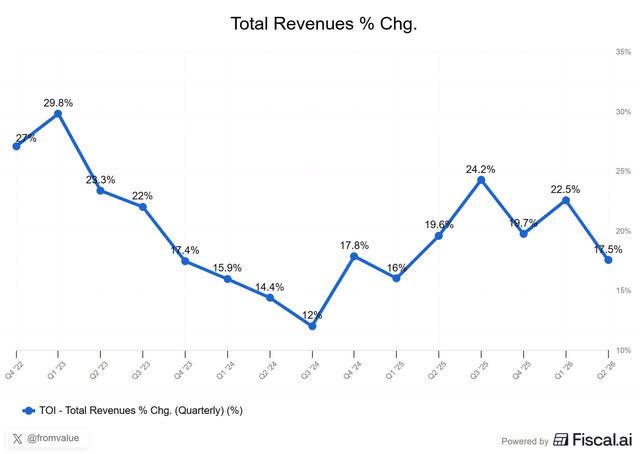
Revenue came in at €437.3M, up 17.5% from €372.0M. For the first half of the year, it was €872.9M, up 20%.
If you want Fiscal AI as well, you get a 15% discount with this link
That 17.5% is the slowest growth since Q1 2025. But actually, it’s pretty strong because of the tough comps. Last year in Q2, Topicus spent €210M on acquisitions, with Cipal Schaubroeck as the big one.
On top of that, the largest investment since then, a bit more than €400M for the stake in Asseco Poland, doesn’t add a single euro of revenue. Topicus owns 23% of Asseco, not a majority, so what it earns there is not in revenue. In that context, I think this 17.5% is still pretty strong.
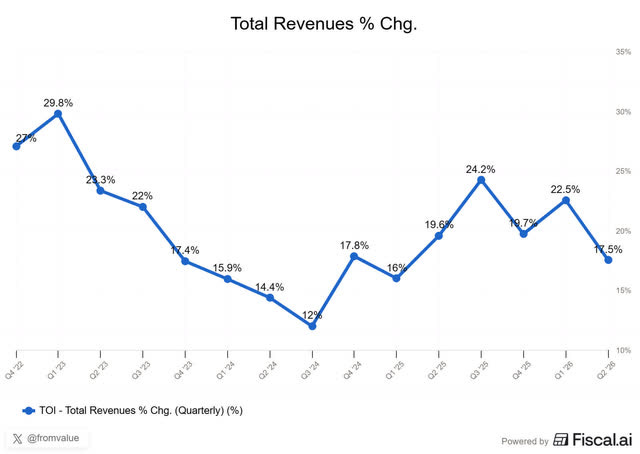
Organic growth (growth without acquisitions) was 4%. It has been 4% or 5% in 8 of the 9 quarters.
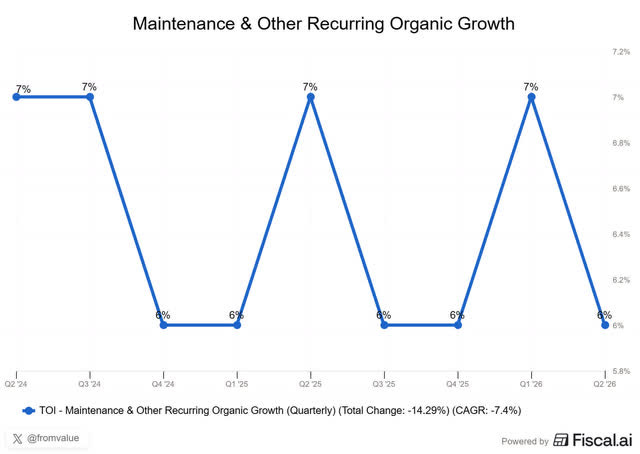
Maintenance and other recurring revenue grew 6% organically. Here the consistency is even bigger, with 6% or 7% in all of the last 9 quarters.
If you look at Constellation without Topicus and Lumine, it had 0% organic growth in Q2, and Lumine 1%. Topicus did 4%. If you see this as a family, the European child is growing fastest. Great to see.
Operating profit before amortization was €103.4M, up 17% YoY. Net income rose 14% to €47.3M, €0.36 per share. In H1, net income was down 8%, but I already explained that in the Q1 article. H1 2025 had a one-off paper gain of €32.8M on the first Asseco shares. If you take that out, pre-tax income was up 26%.
Just a reminder: Q1 is always a strong quarter for Topicus. Usually, maintenance invoices are sent in that quarter and that means a lot of money comes in that quarter. Q2 is usually the weakest quarter. That’s why you will see negative operating cash flow of €12.7M this quarter. It is better than last year’s Q2, which was minus €14.9M. In H1, this was €267.8M, up 4%. That money is great, because it can be redeployed into new businesses.
But the number that really matters for Topicus is free cash flow available to shareholders, or FCFA2S. Like Constellation Software, Topicus reports this every quarter. It’s the cash left for shareholders after interest, leases, equipment, and the minority partners’ share. In other words, despite the many adjustments, it’s actually the clearest number. It was €14.6M in the quarter, much better than the negative €16.7M in Q2 2025. In H1, it came in at €180.1M, up 24% YoY.
I have always said you shouldn’t look at a single quarter for Topicus (and Constellation Software), so here is what it looks like over the last twelve months.
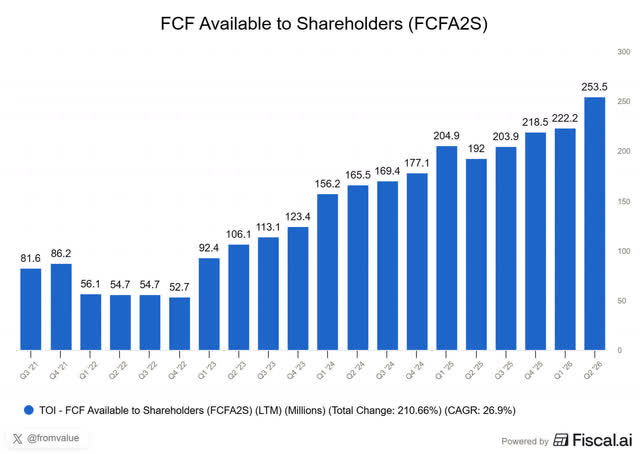
That looks great but it’s a bit distorted. From the MD&A:
The increase in FCFA2S is primarily due to a dividend in the amount of €59.0M that was received from Asseco in Q2 2026 as compared to €7.7M in Q2 2025.
If you ignore the dividend in both years, you get €229.2M, compared to €223.0M. That’s 3% growth, not much better than the 2% of Q1. Of course, the Asseco deal is worth something, but still, you want to see some more growth.
So, is something wrong with it growing so slowly? I don’t think so. Operating profit before amortization is up 24% in H1, so the businesses are doing well. Timing is the main reason for the meager growth. Working capital brought in €71.3M, down from €93M last year. That seems alarming, but it’s not. This has nothing to do with the operations of the company. Customers brought in 14% more prepayments. But cash taxes were 55% higher than last year.
But back to the Asseco dividend. Topicus borrowed to buy that stake, and the interest on that debt is fully deducted from FCFA2S. So, that has a negative influence. That’s why throwing out the Asseco dividend is not fair. And it’s not as if Asseco will stop paying dividends. Just don’t expect the dividend to be that high every year.
This year, Asseco paid out triple last year’s dividend. Only 40% of this very high dividend was from last year’s earnings. The rest came from cash on the balance sheet. If you dive a bit deeper, there’s actually a funny detail.
Topicus bought the largest part of its stake directly from Asseco, the so-called treasury shares, shares a company holds in itself. Topicus paid 1.05B zloty. And how much has Asseco paid out in dividends? You guessed it, 1.05B zloty. It’s probably a coincidence, but still, it says something. The money that Topicus invested was already paid back in dividends for 23.14% in year one. Because that’s how big Topicus’ stake in Asseco is.
Now, as often with Topicus, you have to adjust things. The Asseco dividend is not in Topicus’ profit. The dividend lowers the value of the stake on Topicus’ balance sheet. On top of that, Asseco’s stock also dropped YTD, by about 28%.
Topicus has €323.3M in cash and €467.7M in debt. This Fiscal chart shows €561.6M because, in total debt, lease obligations are also included.
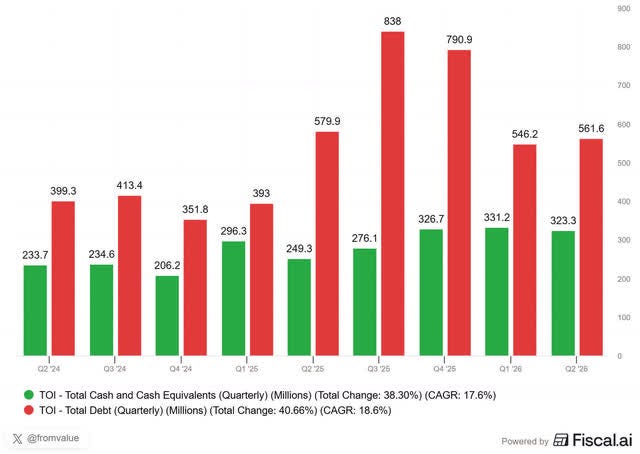
We will go with the numbers Topicus gives, because these are more about the operating part of the business, and they show you a crucial element. With Topicus’ numbers, net debt is €144.4M, down from €365.9M at the end of 2025. Over the past twelve months, Topicus generated €424M in operating cash flow. That means net debt is about a third of one year’s cash flow. That’s extremely conservative for a serial acquirer, especially if you know that Topicus has spent a record amount buying new businesses.
Topicus has €700M in a revolving credit facility, but it has used only €110M so far. If you add the cash, it means that Topicus could put more than €900M to work without needing any other form of financing.
The MD&A states this in the company’s typical matter-of-fact tone:
Management anticipates that it can continue to grow the business organically without any additional funding.
This is the internal flywheel that I find very attractive. Many private equity companies that often compete with Topicus are leveraged over their ears and are therefore very risky investments. Topicus is extremely conservatively managed and it can easily weather any storm. No, I should rephrase that. It is anti-fragile, as Nassim Nicholas Taleb described it in his great book with the same title.

The subtitle of the book says it all: “Things that gain from disorder.” If there is a crisis, Topicus will gain strength, while its competitors will suffer or even go out of business.
But that also means that Topicus’ acquisitions come in at an irregular pace. Last year was a record year for cash deployment, this year is slow up to now.
In the second quarter, Topicus closed acquisitions for €31.2M in cash, or €40.2M including milestone earnouts. That means €62.7M this year so far. Last year, in H1, that was €249.7M in cash for businesses plus €168M for the first Asseco shares (Topicus bought its stake in two times).
Of course, 2025 was a record year, a true outlier. But good deals that meet Topicus’ hurdle rate come at an irregular pace. For example, since the quarter ended, Topicus has completed or committed to deals worth €56.1M. That’s almost as much as the rest of the year combined. I see this as prudent and consistent with why I bought the stock. Topicus doesn’t lower its bar to just show growth. It waits patiently until it sees a good opportunity that meets the hurdle and only then it deploys money. That’s what sets it apart.
And there was a very public showcase of the attitude Topicus has. At the end of May, it made a public offer of 247M Australian dollars for ReadyTech, an Australian software company. ReadyTech’s Board refused the offer. As far as I know, Topicus has not put in a higher bid. But it shows that Topicus is ready to write a check €100M+ if it sees an opportunity. Probably, a higher price would not meet the hurdle rate. Or put differently, Topicus thinks its returns would not be high enough for a higher bid to make sense.
So the business is doing fine. But what about the CEO suddenly stepping down? Why so fast, after sixteen years? Why no explanation? And is it a coincidence that a second key person left at almost the same time?
I dug into it, and I found more than the press release tells you.
Below: what’s really behind the CEO change, the second departure few talked about, the three numbers that would show AI damage first, the two scores I just cut, the valuation at a level I have never seen before, and my rating.
Don’t want to miss it?
This link gives you a $100 discount. Or a $250 discount if you take the VIP (with my real-money portfolio).
Don’t miss it.