

Hi Multis
Ah, Cloudflare (NET). I’m always happy to write an article about it. Matthew Prince is one of my favorite CEOs and of course, the fact that it’s a Potential Multibaggers stock since it traded at $39 in 2020, also helps. It’s at $360 now, so it’s getting pretty close to being a tenbagger.

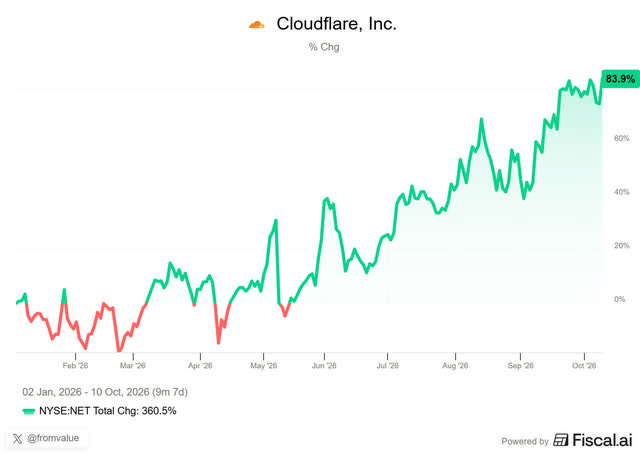
The company reported its Q2 2026 results on August 6. I was still on holiday then and when I got home, I prioritized more urgent earnings first. But in a month or so, the company will release its Q3 results and the price has surged 23% since the earnings. Year to date, the stock is up 84%.
(Seriously, why don’t you have a Fiscal subscription yet? With this link, you get a 15% discount.)
That’s why I wanted to write this article now. Of course, near the end of this article, as always, we will look at the valuation, but first the fundamentals.
On September 9, CFO Thomas Seifert spoke at the Goldman Sachs technology conference and I listened to that interview as well. And, in the week that it’s my birthday, the last week of September, Cloudflare always holds its Birthday Week. We will mention a few things from that event as well. So, there’s a lot to cover. Let’s go.
The Numbers
Revenue: $696.1M, +36% YoY, another revenue growth acceleration, after 34% growth in Q1. It beat the consensus by $29.75M.
Non-GAAP EPS: $0.29, $0.02 above the consensus.
Free cash flow: $56.4M, 8% of revenue, up from $33.3M a year ago.
RPO: $2.732B, +38% YoY. RPO is the remaining performance obligation, revenue that’s under contract but not booked yet.
DBNRR: 120%, up from 118% in Q1. Dollar-based net retention shows what customers from a year ago spend now, including churn.
Large customers (over $100K a year): 4,698, +27% YoY, up from 25% growth in Q1. These big customers bring in 73% of revenue.
Paying customers: more than 80,000 added in the quarter, +74% YoY.
U.S. revenue: +41% YoY, 51% of the total.
Cloudflare added 986 large customers over the past year, the most in its history, and every tier from $100K to more than $5M set a record. The acceleration is also clear in new customer bookings, which grew at the fastest rate in more than five years.
Guidance also did better than expectations. For Q3, Cloudflare expects revenue of $736M to $737M, or 31% growth. For the full year, revenue guidance rose from $2.805B-$2.813B to $2.864B-$2.870B (32% growth), and EPS guidance rose from $1.19-$1.20 to $1.25-$1.26. A lot of numbers, I know, but they are all good and rising.
In my Q1 article, I wrote that I was pretty confident that Q2 would come in higher than the guidance of $664M to $665M. It came in about $31M higher. The full-year raise is about $58M at the midpoint, so management also lifted its expectations for the second half by roughly $26M. And I’m confident that they will beat that guidance again.
More Than Half Of The Traffic Is No Longer Human
In Q2, for the first time, more than half of the traffic on Cloudflare’s network didn’t come from humans.

Source: Q2 2026 earnings slides found on Fiscal.
In the call, Matthew Prince said (my bold):
I think it’s a pretty wild time.
I was asked at the end of 2025, in November of 2025, when I thought that non-human traffic would pass human traffic. We pulled all the data, we ran all the numbers, and we were pretty confident that it was going to be the second half of 2027.
I was asked the same question again in March of 2026, and we did the same exercise, and we were surprised to see that it had moved up, that it would cross in the first half of 2027.
I was quite surprised when, in May of this year, our team came to me and said, “You won’t believe it, but non-human traffic has now passed human traffic online.”
To give you a sense of how this trend is playing out, and with the big caveat that I have called it wrong at every point along the way, if the current trends continue, we think in five years, non-human traffic will be as much as 1,000 times as much as human traffic.
It’s not just AI agents, to be sure. There are also hackers and scrapers. Cloudflare blocks those without charging its customers extra, living up to its mission statement:
to help build a better Internet
So more traffic doesn’t automatically mean more revenue. Cloudflare earns on the traffic its customers want, not on what they don’t want.
Most software is sold per seat, which means you pay for every employee who uses it. That’s a problem when companies need fewer people to do the same work because AI agents can do it. Cloudflare was never a seat business, but it wasn’t a consumption business either: most customers pay a fixed subscription for a usage tier. What’s changing is that a growing part of revenue is billed on what customers use: requests, compute and storage. Agents produce far more of those than people do, so that’s why Cloudflare’s revenue is accelerating.
In the Q1 article, I wrote about the T-shirt sizes: customers commit to a usage level and move up a size when they outgrow it. That means that revenue follows usage with a delay. Many large customers also have a pool of funds, a set amount they can spend on any Cloudflare product. In Q2, they used up those commitments faster than Cloudflare had forecast. CFO Seifert:
If it is a pool of funds contract, people burn through their commitments way faster. We renew mid-quarter.
And during Birthday Week, Cloudflare announced that three usage-based products start billing in Q4: Artifacts (code repositories built for agents), AI Search and the observability tools.
So what about the Q3 guidance of 31% growth, after 36% in Q2? That looks like a slowdown. But don’t forget that management guided 30% revenue growth for Q2 and came in at 36%.
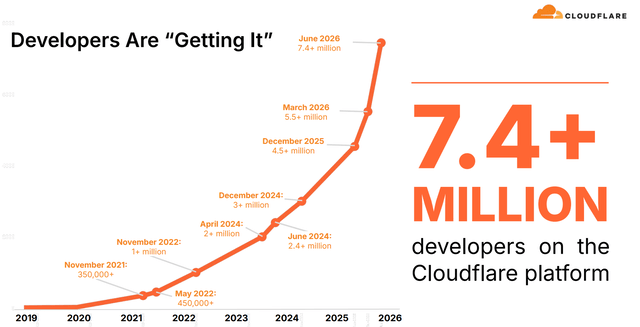
Cloudflare ended the quarter with more than 7.4 million developers, up from 5.5 million three months earlier. Pretty impressive.
Matthew Prince was surprised as well:
I made the team triple-check the developer numbers because we added more developers in a quarter than we did in all of last year, and we thought last year was pretty good.
Many of these new developers never wrote code before. Prince gave an example from his own office:
My EA is using some of the vibe coding platforms in order to build tools in order to run things around her house, and she’s writing code and deploying it to Cloudflare, and that’s really remarkable.
Platforms like Lovable, Replit and Base44 let anyone build an app by describing it. A lot of that code runs on Cloudflare.
For years, management said that Workers, the developer platform, was about adoption and that revenue would come later. Prince now says this “has tipped“ and that Workers has become a meaningful contributor to revenue.
I also like how durable this revenue is. A customer who builds their product on Workers keeps paying for as long as that product is active. CFO Thomas Seifert said it’s still the fastest-growing part of the company, followed by the Zero Trust security products.
In June, Cloudflare bought VoidZero, the company behind Vite, one of the most-used tools for building web applications. We already mentioned that in the Overview Of The Week at the time.
Vite stays free and open source. Developers and their coding agents already build their apps with it, and Cloudflare wants to make its own platform the easiest place to run those apps.
Something else happened after the quarter closed. Five days after the earnings, Cloudflare issued $2.175B of convertible notes due 2031 at 0% interest. These notes only convert into shares above about $497, a 60% premium to the share price in August. Older notes of about $1.29B were due on August 15, so much of this is refinancing. But if you can borrow more than $2B for five years without paying interest, you would be stupid not to do it in this environment of rising rates. The company will invest in capex in H2 of this year.
If you remember, in Q1, Cloudflare let some people go. The restructuring cost more than planned. Cloudflare booked $151M in Q2 and now expects up to $165M for the year, up from $140M to $150M. CFO Seifert said the company chose speed, especially outside the US, so Cloudflare can stay focused on execution.
The $56.4M of free cash flow in Q2 came after $99M in severance payments. Without those, it would have been about $155M, or 22% of revenue.
Below:
> why more than half of the internet is no longer human (and why that makes Cloudflare more money, not less),
> the new Cloudflare plan that only works if the company builds something 1,000 times bigger than Visa,
> the $2 billion it just borrowed at 0% interest
So the numbers are outstanding again. But what to do with the stock?
Don’t want to miss these valuable insights and don’t want to miss the next Cloudflare?