

Hi Multis
In my last article on Nu Holdings (NU), “Whole Lotta Noisy,” the stock was down 35% from its January high and the bears had a lot to feast on: Provisions up, NPLs up, risk-adjusted NIM down. I told you most of it was seasonality and accounting, and that management had promised margins would return in the second half of the year.
On August 13, Nu reported its Q2 2026 results. The next day, the stock jumped more than 10% and in early September, it was up 15%. Then, on September 10, Nu officially launched in the United States, in a stadium now carrying its own name in Miami. It’s also Lionel Messi’s home stadium.

By the way, I think this is a good investment, as the first target group, Brazilians and other Latin American people living in the US are often as crazy about soccer as the people in their native countries.
But the stock? It went down. Today, it’s flat from before the earnings.
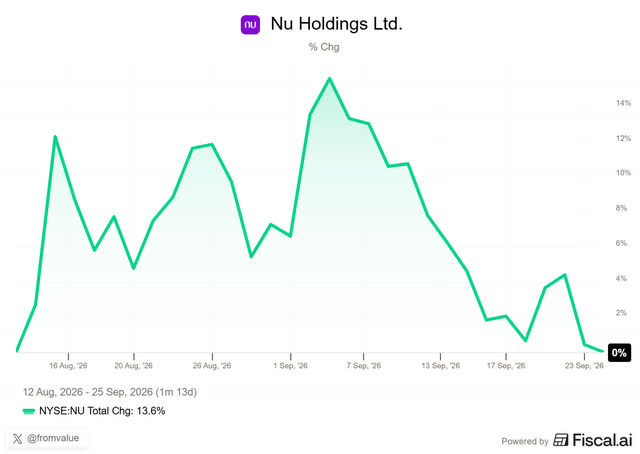
But the stock can be fickle, as we all know. What about the fundamentals? Was Q2 as good as that initial stock jump suggested, or did investors find something more negative in the earnings as time passed? And what should we think of Nu in America?
There’s a lot to cover and that’s why this will be the longest earnings analysis article I have ever written because there’s a lot to unpack: the insights from the quarterly earnings (and there are many), the bear arguments (some sound convincing), what Mexico is really worth for NU, of course, the US launch, and at the end, as always, the Selling Rules, the Quality Score, the Valuation and my Buy-Hold-Sell rating.
But first, the numbers.
The Numbers
(FXN = FX-neutral, the growth without currency effects.)
Revenue: $5.88B, +39% YoY FXN, beating the consensus by $390M.
EPS: $0.24, beating the consensus by $0.04.
Net income: $1.06B, +49% YoY FXN, +17% QoQ. The first billion-dollar quarter in Nu’s history. Hooray!
Gross profit: $2.44B, +43% YoY FXN, +25% QoQ.
Customers: 138.9M, +13% YoY, 4 million net adds in the quarter.
Activity rate (monthly active customers divided by total customers; a customer is active if they generated revenue for Nu in the last 30 days): 83.5%, and in Brazil more than 86%.
ARPAC (Average Revenue Per Active Customer): $17.1 per month, +22% YoY FXN.
Cost to serve: $1.0 per active customer per month, +14% YoY FXN.
Credit portfolio: $39.4B, +37% YoY FXN, +5% QoQ.
Deposits: $45.3B, +18% YoY FXN, +6% QoQ.
NIM (net interest margin): 22.9%, up from 21.1% in Q1.
Risk-adjusted NIM: 12.4%, from 9.5% in Q1 and 9.9% a year ago.
Efficiency ratio (operating expenses divided by net revenue, so lower is better): 19.5%, from 17.6% in Q1 and 21.3% a year ago. That means Nu spends $19.5 to earn $100 in net revenue. Very strong, especially if you know that traditional Brazilian banks are between 40% and 50%.
ROE (return on equity): 33%, a record high, together with Q4 2025.
NPL 15-90 (loans 15 to 90 days late): 4.8%, down from 5.0% in Q1.
NPL 90+: 6.9%, from 6.5% in Q1 and last year.
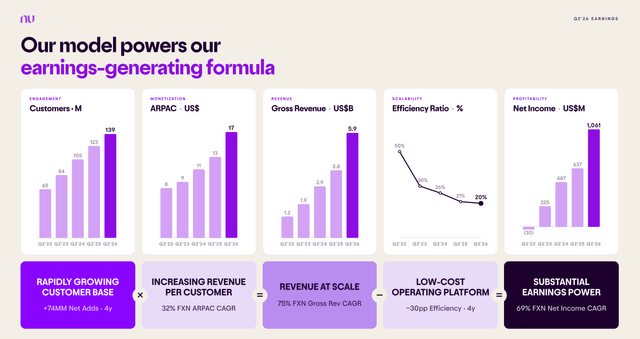
Here, Nu sums up key metrics. It’s impressive: 4 years ago, Nu lost $30M in Q2; now it has earned $1.061B. That’s impressive growth. In the same period, the efficiency ratio went from 50% to 20%.
On the call, JPMorgan analyst Yuri Fernandes pointed out that the retail operation of Itaú Unibanco, the biggest and probably best-run incumbent bank in Brazil, makes around $1.1 billion per quarter. Nu is almost there already.
In Q1, risk-adjusted NIM (net interest margin) dropped to 9.5%. Risk-adjusted NIM is the margin Nu makes in interest, after subtracting funding costs and credit losses. Management promised it would move back toward the levels of the second half of 2025, which means 10.5% to 10.8%, “over the coming quarters.” So, it was one of the first things I looked at.
And what did we see this quarter? Risk-adjusted NIM at a whopping 12.4%. In one quarter. That’s crushing it and blowing past all the expectations.
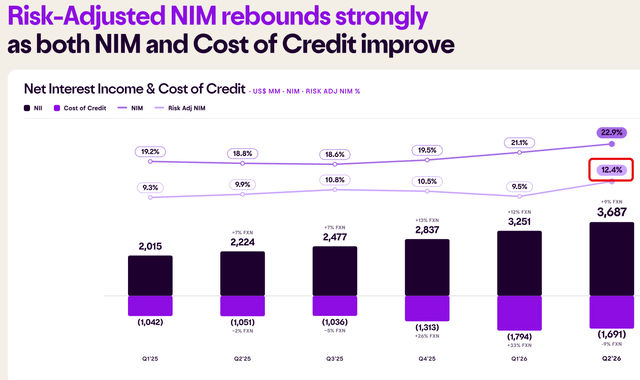
In my Q1 analysis, I explained the IFRS accounting rule that caused the Q1 dip: when a bank writes a new loan, it has to book the expected lifetime loss on that loan immediately, before it earns a single dollar of interest. Nu grew very fast in Q1, so it took the losses upfront. In Q2, the interest income on the loans from Q1 started coming in.
The efficiency ratio went from 17.6% to 19.5%. That’s still very impressive, but it’s a bit worse than in Q1. But in Q1, management already said that two-thirds was timing that wouldn’t last. Full-year guidance for efficiency ratio remains 20%, including the investments in the US.
This is where the article stops if you are a free reader. Premium readers get much more than you, obviously.
Did you know there’s a VIP subscription too? It costs $1,200 and you get my full portfolio there. I’m extending the services you get in the VIP subscription soon and the price will go to $1,500 (or even more).
But right now, you can get a free upgrade to VIP for the very last time ever (!!) for just $399. That’s less than the regular subscription. And, on top of that, you will keep VIP access for the regular subscription price as long as you don’t cancel your subscription. That means you save $1,001 every single year.
The action is almost over. Unlock this article, unlock all other articles, unlock my portfolio, unlock the future webinars and unlock access to me directly on our platform. All this for just $399 (last time ever) for a full year VIP membership.
Only if you use this link.
Don’t wait. Soon, this promotion is gone. Forever.