

Hi Multis
Last quarter I wrote an article called “Is This The Explanation?” I put forward a hypothesis: that the high growth in Joint Business Plans and the weakness in headline revenue could be two different sides of the same coin, that The Trade Desk (TTD) was circumventing the ad agencies to the brands themselves, and that this explained both the numbers and Jeff Green’s uncharacteristic silence.
I have to take that thesis back today. Not because the quarter was bad, though it was awful, but because Green himself said the opposite during this of what I thought could be the reason.
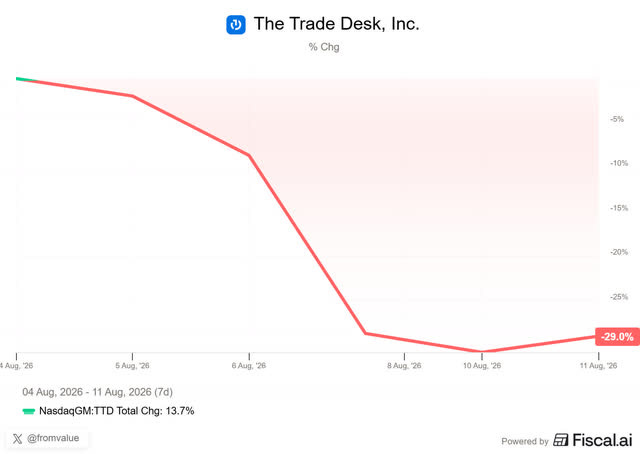
The stock fell about 22.5% after the results were announced and kept sliding.
In July 2024, I gave The Trade Desk a Valuation Score of 3/10. Since then, the stock is down 86%, even though it initially continued to go up.
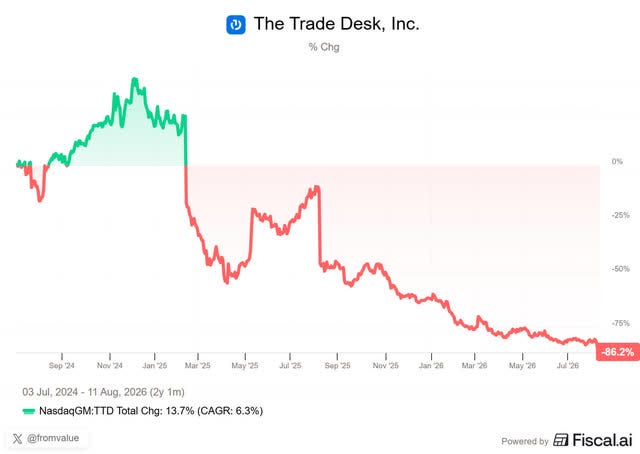
From the absolute top, it’s down even more, 90%. In the last two quarters, I was very critical of the company, and on top of that, the Quality Score deteriorated substantially. Unfortunately, this quarter is even worse.
The Numbers
Revenue came in at $715.1 million, up just 3% year over year, against a consensus of $751.4 million. That’s a miss by 5%, which is a lot for a revenue miss. And don’t forget that the consensus was already down because of the weak guidance in Q1.
But the consensus is not the number that matters the most here. The Trade Desk itself guided for “at least $750 million” three months ago, when Q2 was already well underway. They came in $35 million below their own minimum. That big revenue miss is a big part of the big price drop and I understand the market.
Profitability was not better. Non-GAAP EPS came in at $0.34, missing by $0.06. GAAP net income was $64.4 million, or $0.14 per diluted share, down 28.6% from $90.1 million. Income from operations fell 13%, from $116.8 million to $101.6 million.
Adjusted EBITDA was $241.3 million, a 33.7% margin, down from $270.8 million and 39% a year ago. So EBITDA declined 11% in absolute dollars, not just as a percentage. All these numbers look really bad.
The hit to profitability came partly from taxes. The company paid $48.7 million in taxes on $113.1 million of pretax income. That means a tax rate of 43%, against 32% a year ago.
Total operating expenses were $613.5 million, up 6% but excluding SBC, up 12%. This was mainly driven by platform operations, which were up 22% to $184.3 million. That is the data center and AI infrastructure build-out that has been going on for a few quarters now.
The Trade Desk repurchased $78 million of stock in Q2, with $269 million left on the authorization. That is about half the $164 million they bought in Q1. I don’t find this very confidence-inspiring. In the quarter the stock collapsed, with $1.5 billion in the bank and a lot of the buyback program left, they cut the buyback in half. Is this because of the new CFO or just because the company lost its faith in its own stock?
The company guided for revenue of “at least” $650 million. While the results were very weak, guidance was even worse. The consensus stood at $806.5 million. That’s a miss by a whopping 24%. For revenue, this is almost unprecedented. Adjusted EBITDA is seen at about $160 million.
In Q3, revenue came in at $739.4 million, so with guidance of $650 million that’s a YoY decline of about 12% and 9% below the quarter the company just reported. I can’t say anything else than that this guidance stinks. Very, very bad and disappointing.
Look at this list:
Q1 2025: 25.4%.
Q2 2025: 18.7%.
Q3 2025: 17.7%.
Q4 2025: 14.3%.
Q1 2026: 11.7%.
Q2 2026: 3.0%.
Q3 2026 guidance: -12%.
This is just horrible.
And there is a detail that makes the 3% of this quarter even worse. The new CFO (another one), Nate Olmstead, said this on the call:
We also benefited from political spending related to the U.S. midterm elections during Q2.
So, this quarter, the 3% includes a midterm tailwind that did not exist a year ago. In other words, normally, it would have been even worse than 3%.
There is one more way to see how much has changed: the Rule of 40, revenue growth plus margin. A year ago this quarter, that was roughly 19 plus 39, or 58. This quarter, 3 plus 33.7, or about 37. On the Q3 guidance, it implies something in the low teens. Growth and margin used to be communicating vessels. Sometimes, there was more growth and that impacted the margins a bit and sometimes, there was a bit less growth, but then margins were generally better. Now, both go down together. Again, a very bad look.
Management leaned hard on macro. The word was used 14 times during the earnings call. There is definitely some truth in the macro comments. But in the same quarter, Magnite grew its revenue by 17% with CTV up 36%, Meta’s advertising revenue grew 27%, and Amazon’s ad services grew 26%.
I have argued before that Amazon and Meta are not the same as The Trade Desk. But it shows that digital advertising did not slow down to low single digits for everyone. Macro can explain why The Trade Desk is under pressure. It cannot, on its own, explain why The Trade Desk is under so much more pressure than the industry it operates in. Last quarter, Jeff Green explained that most of the company’s revenue comes from Fortune 500 brands that respond differently to macro shocks. That was a reasonable answer for a quarter with 12% growth. It’s not for 3% growth (including extra money from the midterms) and definitely not for the 12% drop guidance.
Customer retention stayed above 95%. It always does. And yet revenue grew 3% and is guided to fall 12%. Retention at The Trade Desk counts the number of companies, not dollars. It is not a dollar-based net retention rate.
There are three explanations for the lower spending:
One: clients cut their total advertising budgets, so spending on the platform fell along with everything else. That is cyclical and it means it will recover.
Two: clients kept their budgets but moved a smaller share of them through The Trade Desk.
Three: gross spend held up reasonably but take rate or revenue mix weakened, so less of that spend converted into revenue.
Management gave us no way to judge on what it is. Gross spend and take rate are only disclosed once a year.
Jeff Green said CPG (consumer packaged goods) and autos together are about 25% of the business and that roughly half of those clients are growing well. He also said the majority of the top 100 accounts are growing double digits, that clients outside the top 500 grew over 50% year to date, and that EMEA and APAC each grew almost 30%.
If you put that together, it looks very bad. If roughly 12% of revenue is the troubled part and the other 88% is genuinely growing at double digits, that troubled 12% has to be down something like 45% to 50% YoY to drag the total down to 3%. That is not cyclical softness but a total collapse. The alternative is that the healthy 88% is not really growing at double digits. One half of the story has to give.
Green said some version of “don’t overstate this” at least four times on the call:
This is more a cyclical issue with a handful of customers, and it’s not hard to look at their earnings and see that they’ve had some challenges. (...) please don’t walk away from this thinking that that’s affecting everyone. It’s actually just a couple of them.
When a CEO tells you four times not to worry, that’s pretty worrying in itself.
Below: I look deeper into the earnings, to understand all details, see a worrying trend that The Trade Desk is not responsible for, update the Quality Score and Valuation Score and ultimately tell you what I'm doing with my position: holding, adding or selling.
Want to find out?