

Hi Multis
Tempus AI (TEM) reported its Q2 2026 results on July 30.

The stock climbed steadily over the next two and a half weeks and was up about 24% by August 17. A week earlier, it was even up almost 35%.
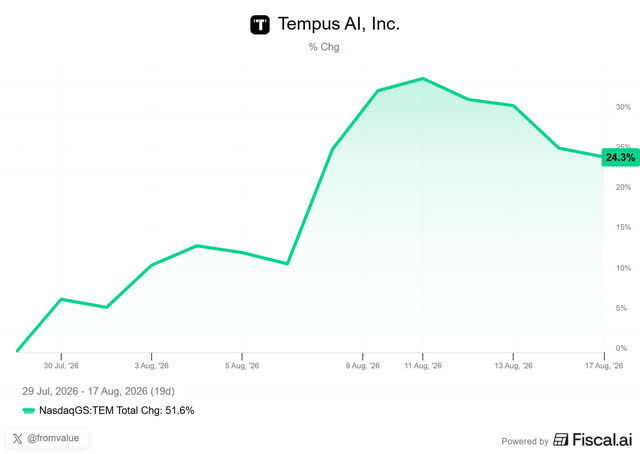
Then, on Wednesday, it jumped again. This time, the reason was that Moderna and Merck published outstanding phase-3 data on their personalized cancer vaccine. We’ll see how Tempus is involved later in this article. This second jump means that Tempus AI’s stock is now up 47% since the earnings.
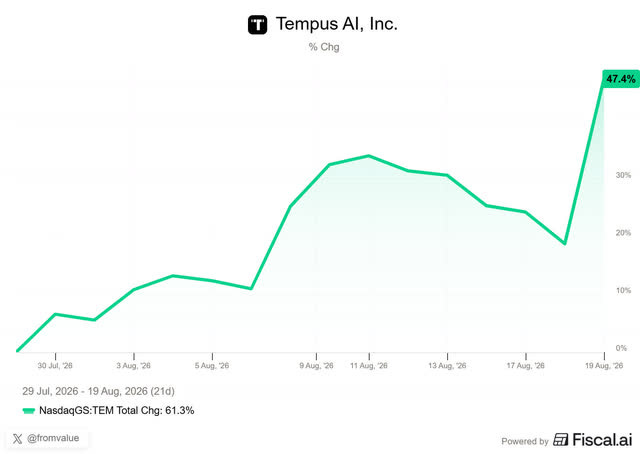
At the same time, it’s still down 35% from its high set in October 2025.
That’s why I prioritized this analysis. I want to know if Tempus AI’s stock is still attractive at this point or not. When it traded at $46.18 a few months ago, I gave it a 9/10 Valuation Score. The uncertainty was the only reason I didn’t give it the maximum score. How about now? Is the stock still attractive for long-term investors?
Let me go through the quarter first. At the end of the article, we’ll look at the Moderna breakthrough. Of course, we will also look at the Selling Rules, the PM Quality Score update and the stock’s valuation to decide if Tempus is still attractive now or if it is time to take profits after this move. So, first to the results.
The Numbers
Revenue: $382.5M, +21.6% YoY, beating the consensus by about $3M.
Diagnostics: $289.3M, +20%.
Data and Applications: $93.2M, +28%, with Insights, Tempus AI’s data licensing and AI modeling division, up 36%.
Hereditary: $107.4M, +5%.
Gross profit: $246.5M, +26%, a margin of 64.4%, up from 62% in Q2 2025.
Non-GAAP EPS: -$0.04, an $0.11 beat, up from -$0.22.
GAAP net income: $5.6M, versus a $42.8M loss a year ago. It was the first positive GAAP quarter ever.
Adjusted EBITDA: $8M, versus -$5.6M in Q2 last year.
Oncology volume: about 96,500 tests, +31%, accelerating from 28% in Q1.
MRD volume: about 9,000 tests, +38% QoQ.
Guidance: full-year guidance raised to $1.595-1.605B, which means about 25% growth YoY.
Here’s a summary from the earnings slides.
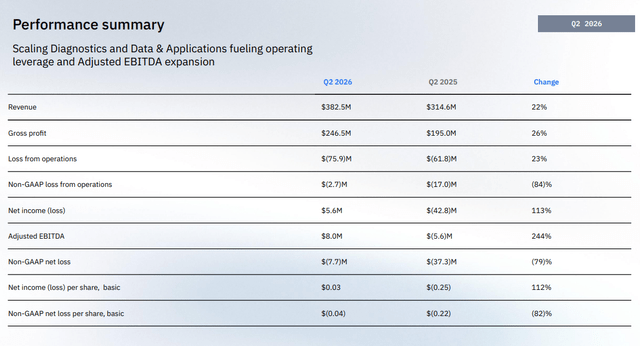
Tempus had its first quarter with a GAAP profit but I think you should ignore it, as it’s only a paper profit. Fair value changes accounted for $97.4M. Tempus already owned about 20% of Personalis and then announced that it will buy the company. The stock shot up because of that and the paper gains of the existing position have to be counted for GAAP. But this is not real profitability.
Loss from operations was -$75.9M, worse than -$61.8M a year ago, mostly because of stock-based compensation. If you strip that out and also the acquisition costs and amortization of intangibles, the non-GAAP loss from operations was -$2.7M versus -$17M last year. So, there is improvement, but with a big asterisk. Non-GAAP net loss was -$7.7M, versus -$37.3M last year.
Hereditary
Hereditary testing looks for cancer risks you were born with, not for a tumor you already have. For example, it can look for a BRCA mutation, which raises the chances of breast and ovarian cancer a lot and healthy women can be screened earlier if they know they have this mutation. Tempus got the biggest part of Hereditary with its Ambry Genetics acquisition in 2025.
But just like last quarter, this section is not doing great. It grew just 5% YoY to $107.4M. CEO Eric Lefkofsky said last quarter mid-teens growth would return in the back half of the year. The explanation is that Q2 2025 was abnormally strong, so the comps are very tough.
Tempus also launched two new tests in the hereditary branch. xH reads the entire genomes of patients with blood cancers such as leukemia and lymphoma. Rare Whole Genome does the same for people with rare diseases that are extremely hard to find. Often, those people already got many tests, and this genome test can finally give them the diagnosis they have been looking for.
Both have just launched and won’t fix the slow revenue growth in Hereditary soon. But they are promising nonetheless.
The ASP Boost
ASP means average selling price: what Tempus actually gets per test from insurers and Medicare. It’s now $1,850, up from around $1,740 in Q1.
There were two important developments this quarter. The first is that the FDA approved xT CDx in its tumor-only version. A tumor-only test reads the cancer alone, without also sequencing the patient’s healthy DNA to compare with. Tempus already had approval for the version that does the test that does both readings.
With this approval, now every solid-tumor test Tempus has can be sold as an FDA-approved test. The result is that Medicare used to pay $2,900 but now pays $4,500. That’s theory, because in reality, not every test gets the full price. Founder and CEO Eric Lefkofsky said you should expect an increase of about $200 per test, or roughly $85 million a year, starting in 2027.
The second development is the expected boost from xF. That is a liquid biopsy test that reads tumor DNA in the blood when you can’t use tissue. The FDA is now assessing the xF test, and CFO Jim Rogers said the company wants to set the price at $7,500 once approved. CEO Eric Lefkofsky explained the reasoning for this price:
And look, it’s an evolving market. Our assay is most comparable in terms of size, like literally size like megabases and size totality to Guardant’s recent assay that they got approved. And I believe their ADLT pricing is something like $8,300 or $8,400. And so we -- it would be very hard for us to go to the market with a almost identical, at least in terms of like size and complexity assay that’s radically less expensive.
Guardant Health’s similar test sets the reference price for other companies. That’s how it often goes in healthcare.
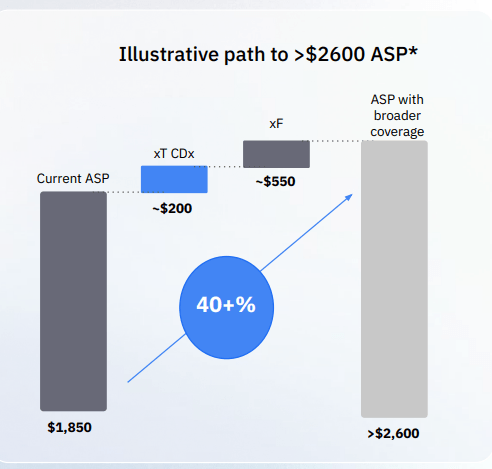
So, you can see that the ASP is currently $1,850. If you add $200 from xT CDx and $550 from xF, then you get $2,600. In other words, that’s 40% more revenue from tests Tempus already has.
I think this is why the stock jumped after the earnings release. Higher profits on the same tests cost almost nothing extra, and that means more gross profit. Right now, Tempus has about 386,000 oncology tests a year. $750 more per test means $290M of extra revenue even if there are no additional tests, which is very unlikely. The number of tests grew over 30% and that’s why management projects about $400 million extra revenue in 2028.
xF isn’t approved yet, though. Lefkofsky expects it in the market in the second half of 2027.
The Data Business
This is the most interesting division of the company.
A few months ago, I gave Tempus a 9/10 Valuation Score at $46.18. The stock is at $72.69 now, up 57%.
Below: how Tempus is connected to the Moderna cancer vaccine breakthrough everyone talked about this week, the reason pharma giants almost can’t leave Tempus anymore, the AstraZeneca test that was passed and if Tempus AI’s stock is still a buy after the jump.