

Hi Multis
Last week, there were 11 Potential Multibaggers reporting and this week four more. That means I have to select the results I prioritize, and your questions are always a guide for me, next to negative stock price movements.
On Tuesday this week, November 10, Sea (SE) announced its Q3 results, and the market didn’t seem to know how to react.
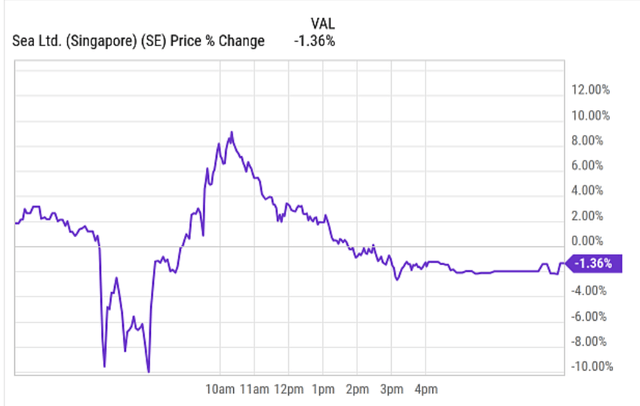
As you can see, first the stock dropped 10%, then it shot up to +9% and then it ended the day slightly down.
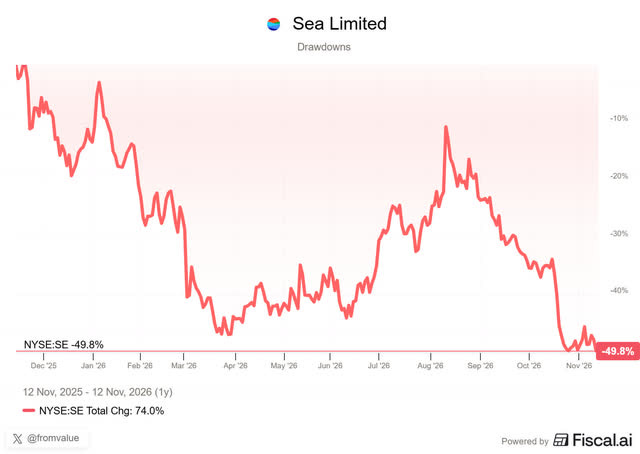
If we zoom out, you can see that the stock has dropped by almost half over the last year.
The question I got most after these results was always the same: why are Shopee’s sales and marketing expenses up 60% while GMV grows just 23%? Isn’t Sea simply buying its growth? It’s a fair question and I’ll answer it later in this article.
Let’s first go over the Q3 results.
Sea Limited Group Results

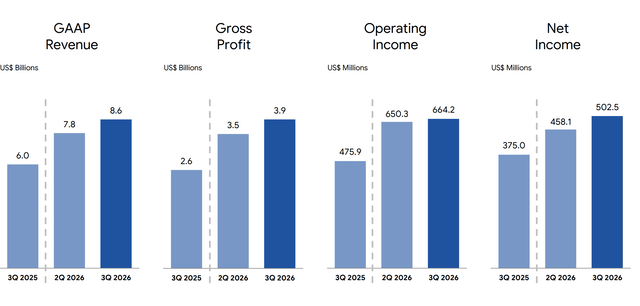
Revenue: $8.58B, up 43.4% YoY, beating the consensus by about 6%. Growth slowed a bit from 48.1% in Q2, but at this size, that’s still exceptional.
Gross profit: $3.94B, up 51.4% YoY. The gross margin rose from 43.4% to 45.9%. Strong again.
Operating income: $664M, up 39.5% YoY.
Net income: $502.5M, up 34% YoY, or $0.78 per share, a slight miss versus the consensus of $0.79.
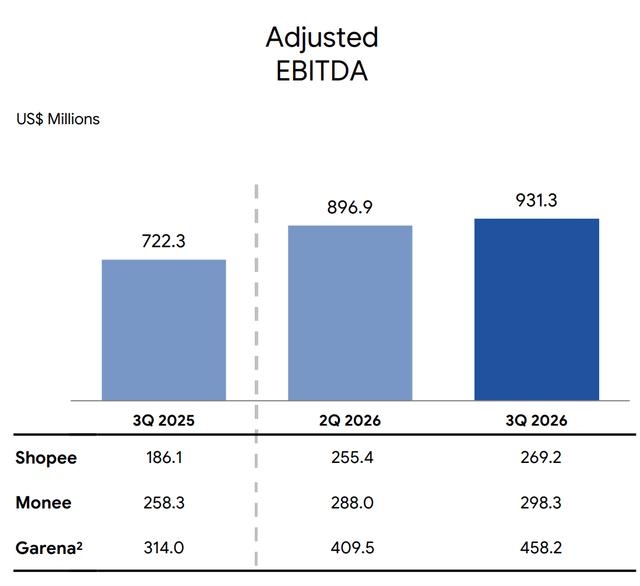
Adjusted EBITDA: $931M, up 28.9% YoY.
From the earnings slide deck, through Fiscal AI (get a 15% discount here)
From the earnings slide deck, through Fiscal AI (get a 15% discount here)
Sea bought back $1B of stock and the board approved another $1B buyback program. At these prices, that makes a lot of sense.
Shopee
GMV (gross merchandise volume, the dollar value of everything sold on Shopee): $39.7B, up 23.3%YoY, or close to 26.5% without currency effects, according to management.
Gross orders: 4.5B, up 25.5% YoY.
Revenue: $6.07B, up 41.3% YoY.
Core marketplace revenue: $4.6B, up 50.6% YoY. These are the seller commissions and ads on Shopee.
Value-added services revenue: $724M, flat YoY. VAS are mostly fulfillment.
Take rate: 15.3%, up from 13.3% a year ago. If you wouldn’t remember: take rate is Shopee revenue as a percentage of GMV.
Adjusted EBITDA: $269.2M, up 44.7% YoY.
Sales and marketing: $1.43B, up 60% YoY.
This was a question I got a lot and that’s why I want to answer it right away: “Sales and marketing spending was up 60%, and GMV was only up 23.3%.” Understandably, that worries some people.
Let’s look at the recent history first.
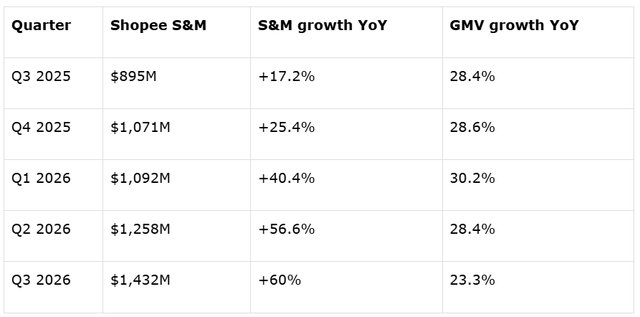
Why does sales and marketing grow 60% when GMV grows only 23.3%? This looks bad, doesn’t it? But there’s context and I would like to point out three reasons.
To start, let’s look at it per $100 of GMV. A year ago, Shopee got $13.30 in revenue on that $100 and then spent about $2.80 on sales and marketing. Now it books $15.30 and spends about $3.60. So marketing per dollar sold rose by about 30%. That’s already another perspective. But because GMV grew as well, you get that 60%: 1.23 x 1.30 = 1.60.
The second reason is that the S&M last year was very low. In Q3 2025, sales and marketing was just 20.8% of Shopee’s revenue, the lowest level in two years. So, the comparison makes S&M jump more. The 23.6% of revenue that’s spent on S&M is about the same as in 2024. 2025 was a year of discipline but in March of this year, founder and CEO Forrest Li announced the switch:
For the near-term, we choose to prioritize growth while upholding financial discipline. For 2026, we aim to grow Shopee’s annual GMV by around 25% year-on-year, with its full year adjusted EBITDA no lower than 2025 in absolute dollars. We believe this is the right strategy to optimize Shopee’s long-term profitability.
And the third and most important reason is that this money is invested in attracting new buyers. Forrest Li this quarter:
We engaged and re-engaged a broad range of users through both online and offline campaigns, brought our content to more social and video platforms, and widened our service options, especially in delivery, to serve different user needs.
The result: the number of new monthly active buyers grew more than 50% YoY, an acceleration from 35% in Q2. If you know the e-commerce business, you already know enough now, but most people don’t, so let me explain it a bit more.
New buyers always start spending slowly. They try the platform with a small first order, maybe a second one a few weeks later. It takes time before they buy higher-priced items like electronics and household goods. But the CAC (customer acquisition cost) comes in at the beginning. Or to put it differently: the LTV (lifetime value) of the new customers can be very high but won’t show up immediately, of course. In other words, if you invest in those customers now, they won’t grow GMV as much as they push up the S&M costs.
The payoff comes over time and it’s expressed in lifetime value. In other words, 60% S&M growth versus 23% GMV growth looks bad if you take these at face value. If you know the industry, listen to management and you see the numbers (especially 50% growth in new monthly active users), management is just investing in its future and that’s exactly what I want my companies to do. If they stop that, growth will drop in a few years, and those criticizing SEA the most now for higher S&M growth will be the first to criticize them when revenue growth drops because they didn’t invest enough now.
To put it differently and summarize it at the same time: the 60% growth in S&M spending should not be seen in direct correlation with GMV growth now, but with (expected) LTV (lifetime value). Just like almost all other e-commerce companies, Shopee doesn’t share LTV numbers. The reason is that if competitors know that, they know how to outbid SEA for media impressions, as LTV is a crucial input in how much you spend on CAC (customer acquisition cost).
There was one more reason why spending more on CAC but I will come back later to that in this article. It’s a good reason.
With that out of the way, let’s look at the other things I saw this quarter.
The business grew 43%, and the stock was cut in half in a year. One of the two is wrong.
Below: the real answer to the question so many of you asked (why does marketing grow 60% when GMV grows 23%?), the IPO logic behind Monee’s spending, what Forrest Li said about Sea Cloud that changes the story from three weeks ago, the Quality Score update and my valuation showing something really surprising.
Don’t want to miss this valuable information?