

Hi Multis
Mercado Libre (MELI) reported its Q2 2026 earnings on August 5. In other words, when I was still in Sardinia. The stock first dropped about 5%, then recovered and is now down 7.6%.
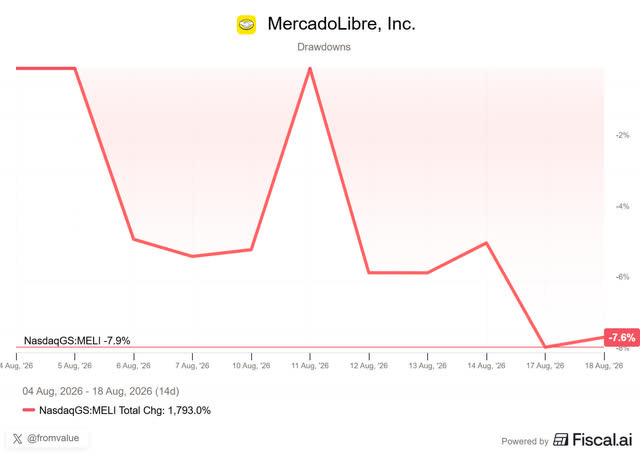
Look at the revenue growth in the last 4 quarters: 39%, 45%, 49%, 50%. That’s impressive.
It was the 30th consecutive quarter of more than 30% revenue growth.
But still the stock is down. Let’s break things down to understand.

The Numbers
Revenue: $10.17B, the first quarter with more than $10B in revenue. It was up 50% YoY in USD, +43% FX-neutral, beating estimates by $378M or 3.9%, which is a lot at this size and with so many analysts following the company.
EPS: $9.19, beating estimates by $0.20, but down 12% YoY
Net income: $466M, -11% YoY, a 4.6% margin
Income from operations: $683M, -17% YoY, a 6.7% margin, down 550 bps YoY but roughly flat versus 6.9% in Q1
Gross margin: 40.9%, down from 45.6%.
Adjusted free cash flow: $214M, versus $454M a year ago
Marketplace:
GMV: $21.9B, +44% YoY, +36% FX-neutral
Items sold: 795.4M, +45% YoY
Unique active buyers: 89.3M, +26% YoY, almost 19 million added in a year
Items sold per unique active buyer: 8.9, +14% YoY. Strong with so many new users.
Same- and next-day shipments: 225M, +38% YoY
Live listings: 859M, +60% YoY
Mercado Pago:
Monthly active users: 88.0M, +30% YoY
Assets under management: $23.2B, +68% YoY
Credit portfolio: $16.4B, +75% YoY, with $15.9B originated in the quarter
Credit card portfolio: $7.7B, +91% YoY, now 47% of the book
TPV (total payment volume): $101.0B, +56% YoY and +56% FX-neutral
NIMAL (net interest after losses): 20.7%, better than the 17.8% in Q1
Advertising: +73% YoY in USD, +62% FX-neutral
Revenue by country: Brazil $5.53B (+59%), Mexico $2.34B (+55%), Argentina $1.84B (+20%), Other $463M (+63%)
As always, Mercado Libre gives a clear overview of the key metrics in the slides.
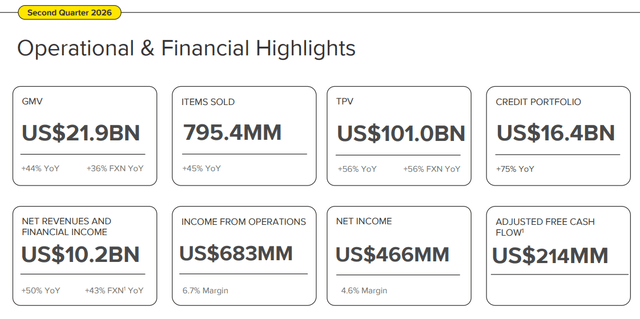
The reason for the price drop is not hard to find. The market saw the same thing: margins down. The operating margin was 6.7%, down from 12.2% last year. It saw the operating income down 17% YoY while revenue grew 50%. If you don’t know the company or what it does, this would be very bad. But it’s not. It’s an intentional investment. That’s also why the margins were more or less the same as in Q1. If this were a breaking company, the margins would keep dropping.
The company gave us a nice waterfall graph again about the margins.
Let me start with the green this time. General and administrative contributed 0.5% to net margins and product development 1.2%. We also already knew this in Q1.
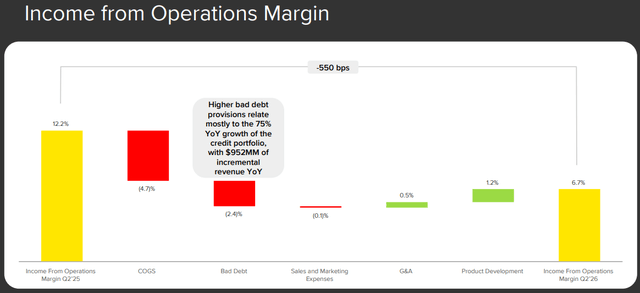
In the COGS, next to the lower free shipping threshold, there were also discounts for buyers who pay with PIX (Brazil’s instant payment system, essentially free for merchants) and lower take rates for sellers in certain categories and price ranges. On top of that, higher shipping costs from higher energy prices and higher POS device costs also played a role. Mercado Libre also decided to spend more to acquire new merchants in Mexico.
Mercado Libre reports under US GAAP, so it must use CECL, which stands for current expected credit losses. This means that from the moment there’s a new loan, Mercado Libre has to write down a provision for all the losses it expects that loan to generate over its entire period. That’s before a single dollar of credit income has come in. If your credit book grows by 75%, this has quite some influence on margins.
Provisions for doubtful accounts came in at $1,276M in Q2, up 85% YoY. That results in 2.4% lower margins. That sounds bad, but let’s do the math.
Credit revenue was $2,278M and provisions for losses $1,276M. The difference is $1,002M, or 9.9% of the company’s total revenue. A year ago, that was $636M, or 9.4% of revenue.
So while the credit book nearly doubled in size, it delivered more profit per dollar of company revenue than it did a year ago, not less. This is very important. The bad debt line is a growth cost that only exists on paper. Sometimes, there’s a gap between GAAP rules and reality.
Brazil, One Year Later
In June 2025, Mercado Libre lowered the free shipping threshold in Brazil from R$79 (about $15) to R$19 (about $3.50). It immediately impacted margin, of course. Many analysts called this a defensive move against Shopee, Temu and AliExpress.
While there may have been some pressure, this is also a typical Mercado Libre move. The company did similar things in the past. Then, the story was that it was a defensive move against Amazon. If it was, it worked like wonders.
And look at what happened since the introduction of the lower free shipping threshold:
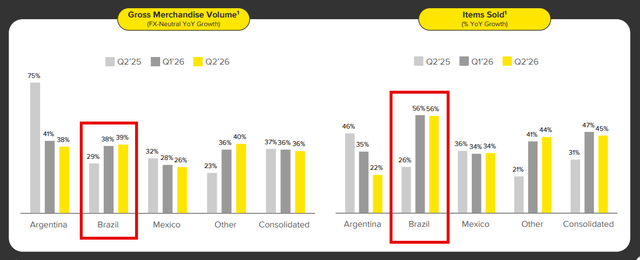
GMV in Brazil: +39%
Items sold in Brazil: +56%
Share of users buying 3+ categories per month: +10 percentage points
Active sellers: +29%
Ecosystemic user growth in Brazil: from 35% before the change to almost 50% now (ecosystemic users are users active on both the marketplace and Mercado Pago).
On top of that, the unit economics keep improving. A decade ago, exactly the same thing happened after the free shipping threshold was lowered. Half of the sales in the price range between R$19 (about $3.50) and R$79 (about $15), the new free shipping range, already recovered the extra cost of free shipping. Mercado Libre could do this through technological innovation, more scale, and filling up capacity that was not used before. In just twelve months, that’s strong.
And because it works so well, management decided to cut take rates in April. CEO Ariel Szarfsztejn explains why:
So yes, I think what we did in Brazil with take rates goes back to the basics of e-commerce, right? So when consumers are deciding where to shop, they are basically looking for the broadest selection at the best possible price with the fastest shipping and the best financing.
And clearly, getting the right selection is a key part of our strategy. That’s why we’ve been doing 1P (when MELI buys and sells products themselves, Kris). That’s why we’ve been doing CBT. (CBT= cross-border trade, Kris)
And that’s why this quarter, as we did back in 2024 and 2025, we decided to lower seller take rates. We’ve already proven that lever, and we’ve consistently seen that every time we lower take rates, we get an acceleration in effective or successful sellers in our platform.
Active sellers grew 29%. So, just like in 2024 and 2025, it worked again. It’s great to see that margins didn’t suffer extra from this move and that Mercado Libre keeps focusing on what is best for the business, not on what Wall Street wants.
Items sold in Brazil grew 45%, while FX-neutral GMV grew 36%. That means average prices came down, exactly what you expect from lower free shipping thresholds, discounts for PIX payments and much more cross-border articles. These cheaper items are exactly Shopee’s, Temu’s and AliExpress’s strength and this number shows that Mercado Libre is winning those customers as well. It’s also the reason the company can sell more items per unique active customer, despite the significant growth in the number of customers. Normally, you’d expect a slowdown.
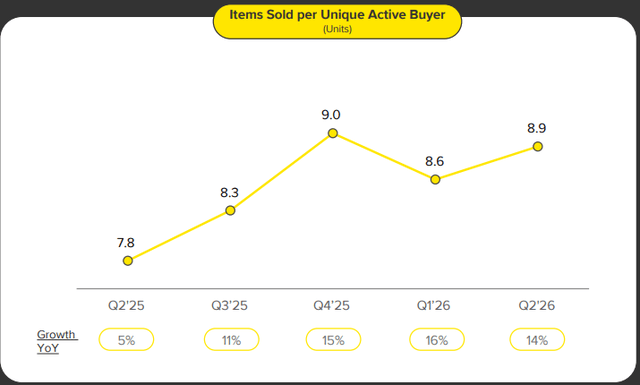
New buyers usually buy very little in the beginning. So the users who were already there must be buying much more than the 14% extra we see.
1 + 1 = 5
Last quarter, I called Mercado Libre a STRONG BUY and I added to my position. The stock is up 23.5% since then.
Below: the brand-new number management just shared that proves that 1 + 1 can be 5, an update on the Selling Rules, the PM Quality Score, the Valuation and whether the stock is still a buy right now.
Don’t want to miss such calls anymore? Subscribe now!