

Hi Multis
When I picked Axon (AXON) in early April, I wrote that I didn’t want the stock price to skyrocket soon, so I could build out my position calmly. Well, the market didn’t listen. The stock is up about 35% since the pick. But fortunately, I didn’t follow up my own advice, as you could see in my buys for the PM Forever Portfolio. I bought faster than I’m used to because I saw the opportunity.
I’m happy for every Multi who started buying with me. But a 35% paper gain in three months says nothing about whether the thesis is right. Stocks move on sentiment over the short term and on fundamentals over the long term. And the long term can feel really long. Sometimes, it’s 3 years, sometimes 5 or even 7.
And on May 6, Axon released its Q1 2026 earnings, the first quarter it reports as a Potential Multibagger.

In the weeks after the earnings, management also spoke at the William Blair, TD Cowen and J.P. Morgan conferences, and hosted a webinar with three police chiefs.
I went through all of the material. That’s why this is just the first article this week. It was a lot to go through. This article is the result of all the material. I’ll try to give you the best insights from all of the sources in this article.
Let’s start with the numbers.
The Numbers
Revenue: $807 million, up 34% YoY, beating the consensus by $27.7 million, or 3.6%. This was the ninth consecutive quarter of 30%+ growth.
Software & Services revenue: $355 million, up 35%.
Connected Devices revenue: $453 million, up 33%. Within Connected Devices, Platform Solutions (counter-drone, fixed cameras, drones, VR) was the strongest grower with 95% YoY growth.
AI product revenue: up more than 700% YoY (from a small base, but still great growth). AI bookings up 140%.
Dedrone: revenue up over 300% for hardware and software. Bookings up 500%.
Annual recurring revenue: $1.5 billion, up 35%.
Net revenue retention: 125%, up from 123% a year ago and the fifth straight year of Q1 improvement.
Future contracted bookings: $14.3 billion, up 44%.
International revenue: up more than 100%, now 20% of total revenue for the second quarter in a row.
Non-GAAP EPS: $1.61 versus $1.47 last year, a beat by $0.01.
Adjusted EBITDA: $201.6 million. 25% EBITDA margin.
Adjusted gross margin: 61.6%, down from 63.6% a year ago.
Free cash flow: negative $54.6 million, versus roughly break-even last year.
You can see some of the numbers on this earnings slide.
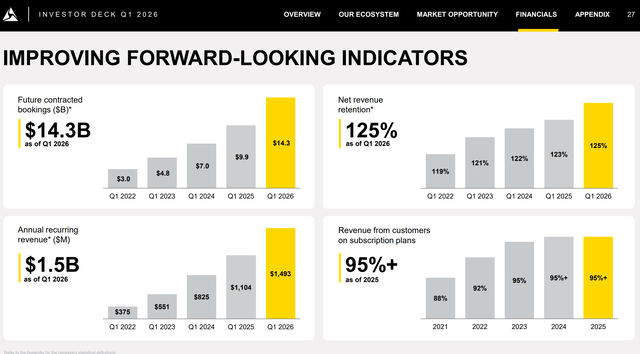
You probably noticed two ugly ducklings in that list: the negative free cash flow and the falling gross margin. Don’t worry, we will get back to this. But first, something in the income statement that most coverage of this quarter got wrong in the other direction: net income.
GAAP net income was $169.3 million, versus $88 million in Q1 last year. Almost a double. Great quarter for profitability, you’d think, right? But if you go to the reconciliation tables in the appendix, you see a line called “Other (income) loss, net” of $189 million. That’s mostly gains on Axon’s investments, so the stakes it holds in other companies. In other words, more than the entire GAAP net income this quarter came from investments going up in value.
The best profitability numbers are the $201.6 million in adjusted EBITDA at a 25% margin and the 75.8% adjusted gross margin in software. Those are earned by the business, not the company’s investments.
Non-GAAP EPS grew only 10% while revenue grew 34%. Interest expense jumped from $7.8 million to $28.6 million because of the $1.8 billion in senior notes raised for the Carbyne and Prepared acquisitions. That’s a conscious move and I don’t care too much about this. The acquisitions were worth it for the long term, in my opinion. I just wanted to point it out.
Free cash flow was negative $54.6 million. That looks bad, but it isn’t.
Q1 is always Axon’s weakest cash quarter because of bonuses, sales commissions, and one of the two semiannual interest payments are all reasons. But the biggest driver was an inventory buildout. CFO Brittany Bagley said that without the inventory investments, free cash flow would have been positive even with all those Q1 payments. president Josh Isner explained the logic behind the buildout on the call:
Given the expanding geopolitical risks, the competition for key components and the growing demand of our products worldwide, we are investing in inventory with durability in mind. We never want inventory to be the reason we cannot maximize our growth and impact.
When hardware companies start to pile up inventory, investors often get nervous but with Axon, it’s safe: its products don’t go obsolete. TASER life cycles are 15 years or so, body cameras definitely more than 5 years, and president Josh Isner mentioned at the J.P. Morgan conference that TASERs launched in 2010 still sell today. This proves that this inventory buildout is not a risk.
Axon said it didn’t suffer from the high memory costs because it had already bought before. This shows the power of having inventory. CFO Brittany Bagley said that the memory impact on gross margin is not even meaningful enough to mention it separately.
On top of that, the full-year free cash flow guidance stayed at approximately $450 million.
Guidance
Axon raised its full-year revenue guidance from 27-30% growth to 30-32%.

The adjusted EBITDA margin guidance stayed at 25.5%, versus 25% in Q1, so management expects operating leverage in the second half of the year.
I also liked that the capex guidance went down, from $185-215 million to $160-190 million. So Axon guides for faster growth and lower spending at the same time. That also makes the free cash flow target of around $450 million attainable, despite the inventory buildout.
Future contracted bookings grew 44% to $14.3 billion. Management expects to recognize 20% to 25% of that as revenue over the next twelve months. That’s $2.9 to $3.6 billion of revenue that’s already signed, against a full-year guidance of roughly $3.6 billion. In other words, most of this year is already under contract. As long as bookings grow more or less in line with revenue, the 30%+ growth can go on for years and I love to see that. It was another part of my investment thesis.
The AI Era Plan: From Curiosity To Default
In Part 1 of my deep dive, I called Draft One the crown jewel of Axon’s AI. And this shows. Revenue grew more than 700%, AI bookings grew 140%, and Josh Isner said that nearly all large domestic law enforcement agencies now include AI in their purchases.
Founder and CEO Rick Smith on the call:
Just yesterday, I hosted a collection of chiefs in San Francisco. Two years ago, when I queried the room who used AI, it was almost 0. Today, it’s 100% are using AI tools in their personal lives daily, but they know those tools can’t be used on government data.
So, every chief now uses AI privately but they are not allowed to use ChatGPT or other LLMs for evidence. But they can use Axon’s AI, as that has all the necessary compliance. That’s why these deals are getting bigger and bigger. There were mentions of contracts of $50 million, $150 milllon and even $200 million with big cities.
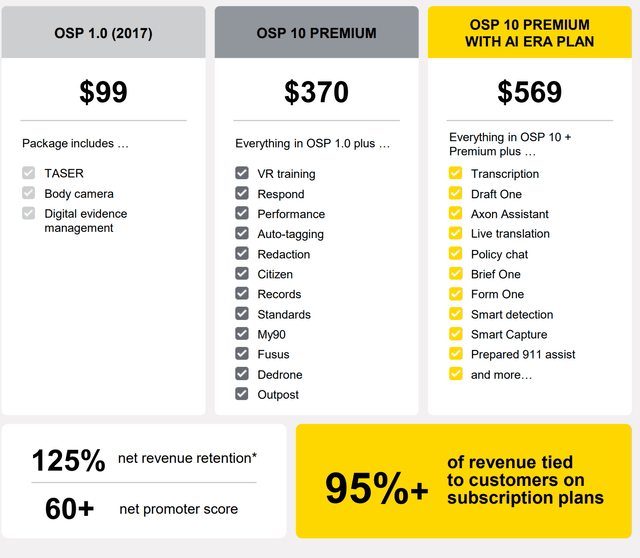
The economics of the AI bundle are great. The original Officer Safety Plan from 2017 cost $99 per officer per month, the OSP 10 Premium costs $370 and with the AI Era Plan on top, it’s $569. That means that the revenue per officer is up almost six times over the years. But still, the customers feel like the winners because new products like Axon Vision are added to the plan automatically. That’s how you get NRR of 125%.
It has to be mentioned, though, that adoption is not completely frictionless. In a customer webinar Axon hosted in June, Chief Darrell Lowe of Redmond, Washington said his prosecutor’s office simply won’t accept AI-generated reports, which makes Draft One unusable for his department. But that’s the kind of resistance that should be expected.
That same webinar also gave a strong data point to support Axon. Chief Doreen Jokerst of Overland Park, Kansas, said that her drone-as-first-responder program gets to scenes 26% faster than her officers.
And how does management think about its own position in this race? Josh Isner, in his typical style:
The Kentucky Derby was last week, the Belmont is in a few weeks, we look at ourselves like Secretariat at the Belmont. We want to be accelerating ahead of everybody in AI.
For the non-horse-racing readers: Secretariat won the 1973 Belmont by 31 lengths, still the record. Modesty is not Isner’s biggest talent. Execution is, fortunately.
I picked Axon in April. The stock is up 32% since then. I’m happy for every Multi who bought with me. If you didn’t, the big question is, of course, if it’s too late now.
Below: my answer, the growth engine almost nobody talks about yet, my proprietary Quality Score for Axon, and much more.
Don’t want to miss opportunities like this anymore?